
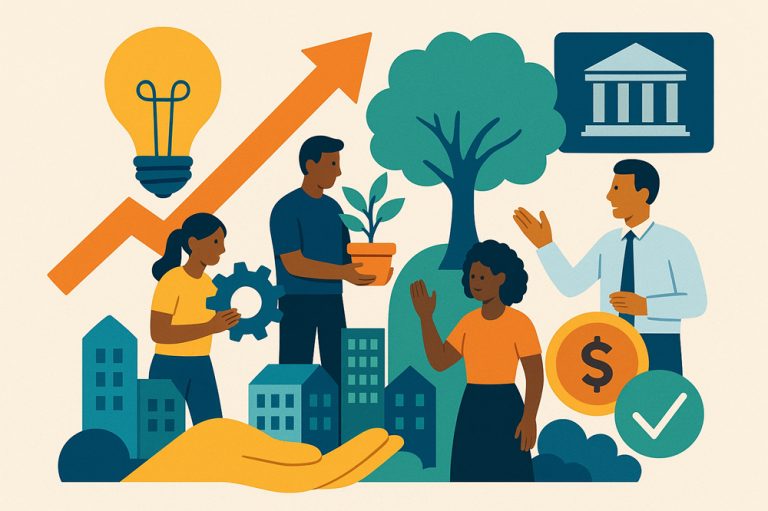
The 2025 Nobel Prize in Economics—awarded to Joel Mokyr, Philippe Aghion, and Peter Howitt for their work on innovation‐driven growth and “creative destruction” —offers a rich lens for thinking about why the interaction (“clash”) between technology and humans often plays out in surprising, non‐linear, and unpredictable ways.
Innovation can ignite growth, but sustaining it requires a fertile ecosystem—of skills, infrastructure, finance, governance, and inclusivity. In developing economies, the challenge is not only to innovate but to ensure that innovation becomes a shared driver of structural transformation and human development.
What the laureates showed
First, some key insights from the prize-winners that set up why the technology-human relationship is messy and unpredictable:
- Creative destruction: Aghion & Howitt’s model shows that innovation doesn’t just add new things; it destroys old technologies, firms, jobs, and business models. The winners of one generation (technologies, firms, sectors) may lose out in the next.
- Prerequisites for sustained growth: Mokyr emphasises that simply inventing new technologies isn’t enough. Sustained growth depends on (among other things):
- a flow of “useful knowledge” (both “propositional” and “prescriptive”) that can build cumulatively,
- institutions and cultural norms that allow experimentation, openness to change, and tolerance of disruptions, even among those hurt by them
- Threats to the “machine” of innovation and creative destruction: They warn that growth can stall if certain negative forces become strong: e.g. monopolistic dominance, resistance by incumbents, restricted academic freedom, regulatory or social pushback, or unequal access to innovation.
- Interplay between science and technology: Before modern growth, many inventions were isolated; what was often missing was deeper understanding (“why things work”) so that innovations could build on each other. When both scientific knowledge and technological application reinforce each other, growth becomes self-reinforcing.
Why the clash is rarely predictable
Given the above, here are reasons why the effects of technology on human societies often turn out differently than expected:
- Non‐uniform distribution of benefits and harms
When a new technology emerges, some people and groups benefit hugely (inventors, early adopters, certain sectors), while others lose out (workers in deprecated industries, firms that can’t adapt). Who wins and who loses depends heavily on context: regulatory frameworks, labor markets, education, geography, social norms. Forecasts often assume smooth transitions, but reality often involves friction, disruption, resistance. - Incumbent resistance and lock-in
Existing firms, institutions, or social structures may resist change to protect their vested interests. They may lobby for regulations that slow disruptive innovations. Technologies may get “locked in” (e.g. fossil fuel infrastructure, or old standards) even when better options exist. These forces are hard to predict in strength or outcome. - Path dependence and historical contingencies
The sequence of developments matters a lot: early choices of institutions, policies, investments affect what comes later. Small differences early on can magnify. For example, whether societies invest in education, legal systems, openness to ideas can set in motion very different growth trajectories. Thus two countries with similar starting technologies may diverge greatly over time. - Uncertainty about side effects / externalities
Technologies often have unintended consequences — pollution, inequality, social dislocation, labor displacement, etc. These effects sometimes only become clear decades later. Policy responses often lag. Also, technologies themselves can create new problems that require additional technology or institutional fixes. - Feedback loops and self-reinforcing dynamics
Innovation can feed on itself, accelerating changes, but also exacerbate inequalities, or concentration of power. For example, a few firms may accumulate so much technological/patent/data advantage that competition is stifled (which the laureates warn about). Once those dynamics set in, they can be hard to reverse. The timing and strength of such shifts are hard to predict. - Regulation, institutional design, culture, politics
These are big wildcards. Governments, social norms, legal systems, cultural reception of new ideas all mediate how technology is adopted. For instance, AI might bring gains in productivity, but whether those gains lead to widespread welfare depends on policies (taxes, education, safety nets) that are political and socially embedded. - Speed of change and scale issues
Some technologies change gradually; others hit like shockwaves. When change is fast, human adaptation lags: in skills, social norms, regulation. Scaling issues (e.g. infrastructure, energy demands, supply of materials) may limit benefits or introduce bottlenecks. - Unknown unknowns
Innovations may open up possibilities that we did not foresee. Some will be beneficial; others may be harmful or disruptive in ways we didn’t imagine. Because science & technology advance, they can do what was previously impossible, altering assumptions.
The observation in the prize: how it relates
When we say “the clash of technology and humans is rarely a plot that plays out in predictable ways,” the 2025 Nobel Prize research supports this statement:
- The laureates stress that technological growth is not self-checking; without suitable supporting conditions (institutions, openness, competition), the “creative destruction” engine can stall or misfire. NobelPrize.org+2NobelPrize.org+2
- They also highlight that while technology can lead to richer societies, it often involves trade-offs: certain classes or places suffer first (job losses, inequality) before gains are spread out. Mortgages of change are uneven and socially fraught.
- The warnings about AI in the current era (from Howitt, Mokyr, etc.) show that even now, we cannot know exactly how many jobs will be lost, how labor markets will shift, how society will reorganize — there are big uncertainties. Phys.org
- Also, the fact that economic stagnation was the norm throughout most of human history until certain institutional, cultural, knowledge conditions were met shows that progress is not automatic. Even when promising technologies are available, without the right environment, they may not produce sustained growth. NobelPrize.org+1
Implications
From this, a few implications follow for thinking about technology, policy, and society:
- We need flexible, adaptive institutions and policies — ones that can respond to unexpected consequences, and manage transitions (e.g. from declining industries).
- Education and human capital become critical: to help people adapt, to enable innovation, to spread benefits.
- Balancing competition and concentration is essential: ensuring new entrants can compete, avoiding monopolistic capture of power in new technologies.
- Ethics, regulation, safety nets cannot be afterthoughts; they shape how disruptive technologies affect humans.
- Monitoring & anticipating side effects, designing with foresight, being open to revising strategies.