
Introduction
In the previous article, we examined the major forms of environmental pollution affecting air, water, and soil. We also discussed the various strategies available for pollution prevention and mitigation. While prevention remains the most effective approach, modern society continues to generate vast quantities of pollutants through industrial production, transportation, agriculture, and urban activities.
The challenge is therefore not merely to prevent pollution but also to transform harmful substances into less harmful forms. This is where chemistry plays a crucial role.
Many pollutants can, in principle, be converted into harmless products through chemical reactions. Carbon monoxide can be oxidized into carbon dioxide. Nitrogen oxides can be reduced into nitrogen gas. Toxic organic compounds can be broken down into water and carbon dioxide. However, these reactions are often too slow or require excessive energy to be practical under normal environmental conditions.
Catalysts provide a solution to this problem. By accelerating chemical reactions without being consumed themselves, catalysts make pollution control technologies both technically feasible and economically viable. Today, environmental catalysis has become one of the most important scientific disciplines supporting clean air, clean water, and sustainable industrial development.
What Is a Catalyst?
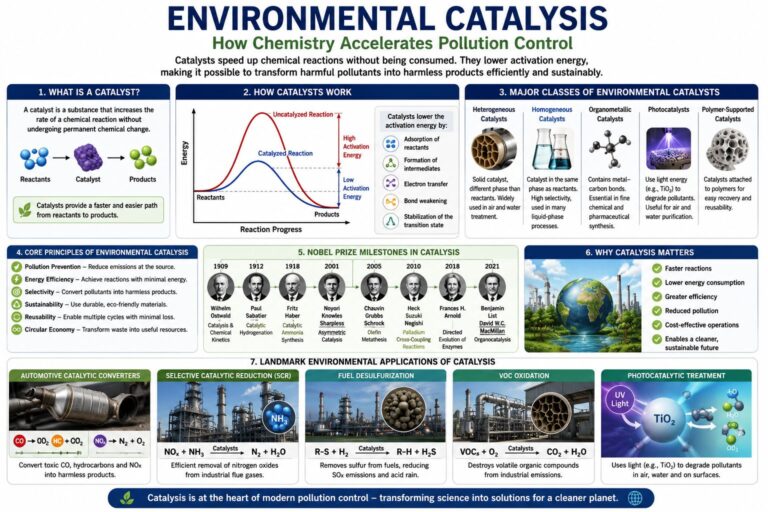
A catalyst is a substance that increases the rate of a chemical reaction without undergoing permanent chemical change itself.
Unlike reactants, catalysts are not consumed during the reaction. A single catalyst molecule may participate in thousands or even millions of reaction cycles before becoming inactive.
Catalysts do not alter:
- The reactants
- The products
- The equilibrium position
- The total energy released or absorbed
Instead, they alter the pathway through which the reaction occurs.
In simple terms, a catalyst provides a faster and easier route from reactants to products.
This seemingly modest capability has transformed modern industry and environmental protection.
Activation Energy and Chemical Reactions
To understand catalysis, it is necessary to understand activation energy.
Even when a chemical reaction is thermodynamically favorable, it does not necessarily occur rapidly.
For example, a pile of dry wood can react with oxygen to produce carbon dioxide and water. However, the reaction does not occur spontaneously because an energy barrier exists between the reactants and the products.
This barrier is known as activation energy.
The concept can be represented as:
Activation energy represents the minimum energy required for reactant molecules to reach a highly unstable intermediate state known as the transition state.
Only molecules possessing sufficient energy can successfully undergo reaction.
In many environmental processes, this energy barrier is too high for reactions to proceed rapidly under ambient conditions.
How Catalysts Lower Activation Energy
Catalysts function by providing an alternative reaction pathway with a lower activation energy.
Instead of forcing molecules to climb a high energy barrier, catalysts create a more accessible route.
Several mechanisms contribute to this effect.
Adsorption of Reactants
Many catalysts operate by adsorbing reactant molecules onto their surfaces.
When molecules are held close together:
- Collision frequency increases
- Molecular orientation improves
- Reaction probability rises
This principle is particularly important in automotive catalytic converters.
Formation of Reactive Intermediates
Catalysts often form temporary intermediate compounds with reactants.
These intermediates are usually more reactive than the original molecules, allowing the overall reaction to proceed more easily.
Electron Transfer
Many catalytic reactions involve movement of electrons.
Catalysts can facilitate electron transfer between molecules, accelerating oxidation and reduction reactions.
Bond Weakening
Certain catalysts weaken chemical bonds within reactant molecules.
This makes it easier for bonds to break and new bonds to form.
Transition State Stabilization
Modern catalytic theory places special emphasis on stabilization of the transition state.
Rather than simply activating reactants, catalysts lower the energy of the transition state itself.
As a result, the energy difference between reactants and the transition state becomes smaller, increasing the reaction rate dramatically.
The Emergence of Environmental Catalysis
Catalysis has long been important in chemical manufacturing. However, environmental catalysis emerged as a distinct scientific discipline during the twentieth century.
Several developments contributed to its growth:
- Industrial air pollution
- Acid rain
- Urban smog
- Toxic wastewater
- Increasing environmental regulations
Scientists realized that catalytic technologies could destroy pollutants rather than merely disperse them.
Today, environmental catalysis forms a cornerstone of:
- Air pollution control
- Wastewater treatment
- Hazardous waste management
- Green chemistry
- Sustainable manufacturing
Core Principles of Environmental Catalysis
Environmental catalysis is guided by several principles.
Pollution Prevention
Prevent emissions before they enter the environment.
Energy Efficiency
Perform chemical transformations using minimal energy.
Selectivity
Convert pollutants into harmless products while minimizing undesirable by-products.
Sustainability
Reduce resource consumption and environmental impact.
Catalyst Reusability
Enable multiple reaction cycles without significant catalyst degradation.
Circular Economy Integration
Transform waste streams into useful resources wherever possible.
Major Classes of Environmental Catalysts
Environmental applications employ several categories of catalysts.
Heterogeneous Catalysts
These catalysts exist in a different phase than the reactants.
Most commonly:
- Solid catalyst
- Gas or liquid reactants
Examples include:
- Platinum
- Palladium
- Rhodium
- Titanium dioxide
- Vanadium oxide
Advantages:
- Easy separation
- High durability
- Industrial scalability
Most environmental technologies rely on heterogeneous catalysts.
Homogeneous Catalysts
These catalysts exist in the same phase as the reactants.
Typically:
- Catalyst dissolved in liquid
- Reactants dissolved in the same liquid
Advantages:
- Excellent selectivity
- Uniform reaction environment
Disadvantages:
- Difficult separation
- Catalyst recovery challenges
Organometallic Catalysts
Organometallic catalysts contain metal-carbon bonds and play important roles in advanced chemical synthesis.
Applications include:
- Pharmaceutical production
- Specialty chemicals
- Fine chemical manufacturing
Many Nobel Prize-winning catalytic discoveries belong to this category.
Photocatalysts
Photocatalysts utilize light energy to drive chemical reactions.
The most important example is titanium dioxide (TiO₂).
When exposed to ultraviolet light, TiO₂ generates highly reactive species capable of oxidizing pollutants.
Applications include:
- Air purification
- Water treatment
- Self-cleaning surfaces
- Smog-reducing infrastructure
Polymer-Supported Catalysts
An increasingly important category involves catalysts attached to organic polymers.
These systems combine catalytic activity with ease of recovery.
Ion Exchange Resins
Widely used for:
- Water purification
- Heavy metal removal
- Wastewater treatment
Chitosan-Based Catalysts
Derived from natural polymers.
Applications include:
- Metal adsorption
- Wastewater remediation
Conducting Polymers
Examples include:
- Polyaniline
- Polypyrrole
These materials are being investigated for pollutant degradation and environmental sensing.
Covalent Organic Frameworks (COFs)
COFs represent a new generation of porous polymeric materials with promising catalytic applications.
Nobel Prize Milestones in Catalysis
The importance of catalysis is reflected by its repeated recognition through Nobel Prizes.
Wilhelm Ostwald
Established the scientific foundations of catalysis and chemical kinetics.
Paul Sabatier
Developed catalytic hydrogenation using metal catalysts.
Fritz Haber
Demonstrated catalytic ammonia synthesis, transforming agriculture through industrial fertilizer production.
Asymmetric Catalysis
Recognized in 2001 for enabling selective production of chiral molecules.
Olefin Metathesis
Awarded in 2005 for a revolutionary catalytic reaction widely used in chemical synthesis.
Palladium-Catalyzed Cross-Coupling
Awarded in 2010 for methods that transformed pharmaceutical manufacturing.
Directed Evolution of Enzymes
Recognized in 2018 for engineering biological catalysts.
Organocatalysis
Awarded in 2021 for the development of metal-free catalytic systems.
Together, these discoveries have shaped modern catalysis and expanded its environmental applications.
Landmark Success Stories in Environmental Catalysis
Automotive Catalytic Converters
Perhaps the most successful environmental catalyst ever developed.
Three-way catalytic converters transform:
- Carbon monoxide into carbon dioxide
- Hydrocarbons into carbon dioxide and water
- Nitrogen oxides into nitrogen gas
Modern vehicles emit only a small fraction of the pollutants produced by earlier generations.
Selective Catalytic Reduction (SCR)
SCR systems are widely used in:
- Power plants
- Industrial boilers
- Marine engines
Ammonia reacts with nitrogen oxides over a catalyst to produce:
- Nitrogen
- Water
Removal efficiencies often exceed 90 percent.
Fuel Desulfurization
Catalytic hydrodesulfurization removes sulfur compounds from petroleum fuels.
Benefits include:
- Reduced acid rain
- Improved air quality
- Cleaner fuel combustion
Volatile Organic Compound (VOC) Control
Catalytic oxidation systems convert hazardous organic vapors into harmless products.
Applications include:
- Paint industries
- Chemical manufacturing
- Petrochemical facilities
Photocatalytic Treatment Systems
Photocatalytic materials use sunlight to degrade pollutants.
Applications include:
- Air-cleaning building facades
- Water purification systems
- Self-cleaning surfaces
Although still evolving, these technologies demonstrate how catalysis can be integrated into urban infrastructure.
Why Catalysis Matters for Environmental Protection
Many pollution-control technologies would be impractical without catalysts.
Catalysts allow:
- Faster reactions
- Lower energy consumption
- Greater efficiency
- Reduced operating costs
- Cleaner industrial processes
Without catalysis, modern air pollution control systems, fuel refining processes, and advanced wastewater treatment technologies would be significantly less effective.
Catalysis therefore represents one of the most important scientific tools available for environmental management.
Conclusion
Environmental pollution presents a complex challenge that requires scientific, technological, and regulatory solutions. Among the available technologies, catalysis occupies a unique position because it enables the transformation of pollutants rather than merely transferring them from one location to another.
By lowering activation energy and accelerating chemical reactions, catalysts make it possible to destroy harmful emissions, purify fuels, treat industrial wastes, and improve environmental quality. From catalytic converters and power plant emission controls to advanced photocatalytic materials, environmental catalysis has already delivered substantial benefits to society.
Yet chemistry is not the only source of catalytic power. Nature itself possesses remarkably sophisticated catalysts known as enzymes. These biological catalysts perform complex reactions with extraordinary efficiency and are increasingly being employed in environmental remediation.
The next article in this series will examine bioenzymes, bioremediation technologies, urban pollution-control experiments, and the future of environmental remediation in an age increasingly shaped by biotechnology and engineered biological systems.