
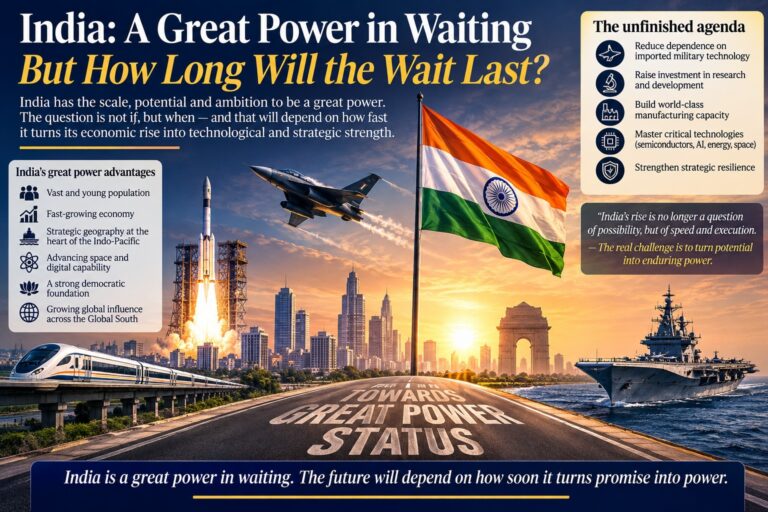
India’s emergence as a Great Power increasingly appears less a question of whether and more a question of when. Yet the second question may prove far more difficult to answer. India possesses many of the attributes associated with major-power status: a vast population, a rapidly expanding economy, nuclear weapons, a large military, a strategically crucial location in the Indian Ocean, a sophisticated space programme, a globally competitive digital sector and considerable diplomatic influence. Its voice carries increasing weight across the Global South, while its ability to maintain relationships simultaneously with the United States, Russia, Europe, Japan and the developing world demonstrates an unusual degree of strategic autonomy.
But Great-Power status is not awarded merely because a country has a large population or a large GDP. Economic size is the foundation of power, not its final expression. The real test is whether a nation can convert its economic resources into technological capability, military strength, industrial resilience, scientific innovation and global strategic reach. On this measure, India’s journey remains unfinished.
This is the central paradox of contemporary India. It is already too large to be ignored, too strategically important to be contained easily and too economically dynamic to remain merely a regional power. Yet it has not fully acquired the technological and industrial autonomy required to exercise Great-Power influence independently.
The most obvious weakness is defence technology. India has built a formidable military, but for decades it has also been one of the world’s major arms importers. Importing advanced weapons is not inherently a weakness; every major power imports some technologies. The problem begins when imports become indispensable to the ability to fight and sustain a prolonged conflict. A country may possess advanced aircraft, submarines or missile systems, but if their engines, components, sensors, ammunition, software or critical technologies depend upon foreign suppliers, its strategic autonomy remains incomplete.
This is why the real measure of India’s military rise should not be how many sophisticated weapons it purchases, but how much of the technology behind those weapons it can design, manufacture, upgrade and replenish itself.
There are encouraging signs. India has moved considerably beyond the old model of simply buying weapons from abroad. Indigenous missile systems, naval platforms, space technology, electronic systems, drones and the expanding defence-industrial ecosystem demonstrate a gradual transition from buyer to producer. The decline in India’s dependence on Russian arms and the increasing emphasis on domestic defence production are signs of a changing strategic culture.
But the destination is much more demanding: India must move from being a producer of weapons to a creator of technologies.
That distinction is crucial.
A modern fighter aircraft is not merely an aircraft. It is the product of decades of research in propulsion, metallurgy, electronics, radar, sensors, artificial intelligence, semiconductors, software and advanced manufacturing. A missile is not simply a tube containing an explosive warhead; it embodies precision engineering, guidance systems, materials science, electronics and computing. A modern warship depends upon propulsion, sensors, communications, cybersecurity, weapons integration and complex industrial supply chains.
Therefore, technological sovereignty cannot be measured simply by counting how many defence platforms carry a ‘Made in India’ label. The more important question is: How much of the intellectual property, critical components and underlying technology is genuinely Indian?
This brings us to India’s greatest long-term challenge: research and development.
India’s R&D expenditure remains modest when compared with the world’s leading technological powers. This is perhaps the greatest contradiction in India’s Great-Power ambitions. India wants to become a leading technological and military power while still investing relatively modestly in the scientific ecosystem that creates technological breakthroughs.
The problem is not simply money. India also needs deeper connections between universities, research institutions, private industry and government. It needs more researchers, stronger basic science, greater private-sector R&D, better funding for deep technology and a culture that tolerates experimentation and failure.
The lesson of countries such as the United States, Japan, Germany, South Korea and increasingly China is clear: Great Powers do not merely consume technology; they create technological ecosystems.
China offers perhaps the most important lesson for India. It once depended heavily on foreign technology and imported sophisticated weapons. Over several decades, however, it used foreign technology as a stepping stone towards domestic capability. It invested massively in manufacturing, engineering, research, infrastructure and technological education. Whatever disagreements one may have with China’s political model, its transformation demonstrates the strategic consequences of sustained investment in technological capacity.
India cannot and should not attempt to copy China. But it must learn the underlying lesson: economic scale becomes geopolitical power only when supported by technological and industrial depth.
This is why India’s future Great-Power status should not be judged primarily by whether its GDP overtakes Germany, Japan or Britain. Such milestones will certainly matter, but GDP rankings can obscure the more important question of quality of power.
A country can have a large GDP and remain dependent upon foreign technology. Another can have a smaller economy but possess disproportionate influence because it controls critical technologies, possesses advanced military capabilities, dominates financial networks or has exceptional strategic reach.
For India, therefore, the objective should be to transform:
economic scale into technological power,
technological power into military capability,
military capability into strategic autonomy,
and strategic autonomy into global influence.
There is another dimension that deserves equal attention: resilience.
A Great Power must be capable of absorbing shocks. It must be able to withstand sanctions, supply-chain disruptions, energy crises, technological embargoes and prolonged military pressure without its economy or defence system collapsing. The Ukraine war has demonstrated how important industrial capacity, ammunition production, energy security and resilient supply chains can become during prolonged conflict.
India’s strategic autonomy will therefore depend not merely on having advanced weapons, but on being able to sustain itself when international circumstances become hostile.
Yet it would be wrong to portray India as permanently trapped in technological dependence. The trajectory is changing. India’s digital economy, space programme, pharmaceutical industry, start-up ecosystem, growing manufacturing capabilities and expanding defence production provide the foundations of a much more technologically capable nation.
India also possesses an advantage that few countries can match: scale.
Its enormous domestic market can support manufacturing at a scale that smaller countries cannot easily replicate. Its young population, expanding middle class, large pool of engineers and scientists and growing technological entrepreneurship provide the human and economic foundations for a major technological transformation.
The opportunity, therefore, is enormous.
But opportunities do not automatically become power.
India could become the world’s third-largest economy and still remain technologically dependent. It could possess one of the world’s largest militaries without possessing the industrial capacity to sustain a major war independently. It could have millions of engineers without producing enough frontier technologies. It could have a large domestic market without becoming a global manufacturing hub.
The difference between potential power and actual power is execution.
This is why India’s Great-Power journey is best described as a race against time.
The world is not standing still while India develops. China is advancing rapidly in artificial intelligence, robotics, semiconductors, aerospace, shipbuilding and military technology. The United States continues to dominate several frontier technologies. Europe, Japan and South Korea retain enormous technological strengths. New technological revolutions are emerging in quantum computing, biotechnology, advanced materials, autonomous systems and energy.
The window for India to convert its demographic and economic advantages into technological power is therefore not infinite.
India is, in many respects, a Great Power in waiting. It has the resources, geography, population, economic momentum and strategic potential. What remains uncertain is the speed at which these ingredients can be transformed into genuine power.
And this raises the most important question:
How long can India remain a Great Power in waiting before the world begins to move faster than India?
The answer will depend less on GDP rankings and more on decisions made today about education, research, manufacturing, defence technology, infrastructure, energy, semiconductors and human capital.
India does not need to become completely self-sufficient. No modern Great Power is. What it needs is strategic technological autonomy—the capacity to ensure that no foreign power can easily paralyse its economy, military or critical infrastructure by withholding a handful of essential technologies.
The ultimate test of India’s rise will therefore not be whether it can buy the best technology in the world.
It will be whether, increasingly, the world needs India for the technologies of tomorrow.
India’s Great-Power status is neither an illusion nor an inevitability. It is a possibility backed by extraordinary resources—but one that must be earned through sustained investment, institutional reform, technological ambition and strategic patience.
India is a Great Power in waiting. The real uncertainty is not whether the door is open, but whether India will walk through it before the geopolitical landscape changes again.