
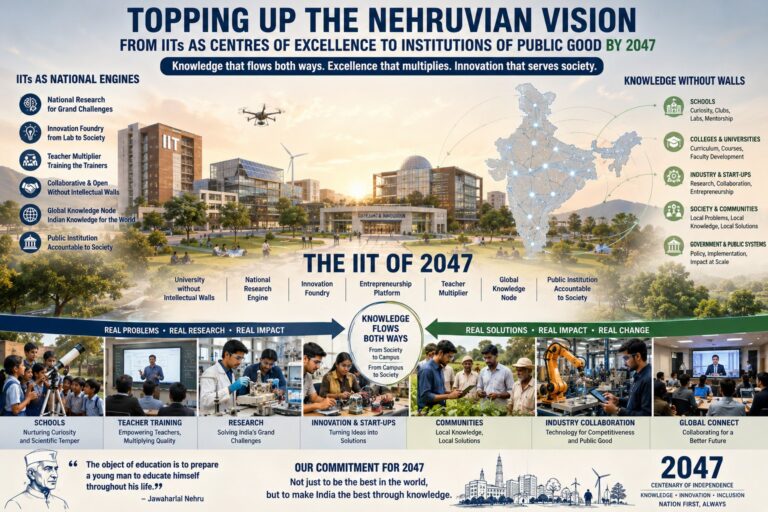
When Jawaharlal Nehru spoke of building institutions of higher learning in independent India, his vision extended far beyond the creation of a handful of elite educational institutions. The establishment of institutions such as the Indian Institutes of Technology (IITs) and the All India Institute of Medical Sciences (AIIMS) reflected a larger nation-building philosophy: create centres of excellence at the apex, nurture scientific temper and advanced knowledge, produce highly trained professionals, and allow the benefits of this intellectual investment to gradually diffuse through colleges, schools and society.
There was an implicit assumption that the top of the educational pyramid would eventually strengthen its base. Over time, excellence in teaching, research and innovation at these institutions would influence the wider educational system. The pyramid would become stronger from the bottom upwards.
There is considerable merit in this vision. India could not have built a modern scientific and technological nation without institutions capable of producing world-class engineers, scientists and doctors. The IITs have undoubtedly contributed enormously to India’s technological capabilities and have produced graduates who have played important roles in India’s development as well as in global science and industry.
Yet, after several decades, an uncomfortable question must be asked: Did the expected intellectual trickle-down actually take place?
The answer is, at best, only partially affirmative.
India today possesses islands of extraordinary institutional excellence alongside a vast educational system where many schools, colleges and universities continue to struggle with inadequate infrastructure, shortage of qualified teachers, weak research cultures and limited exposure to cutting-edge knowledge. The IITs became exceptionally strong institutions, but their excellence did not automatically transform the educational ecosystem surrounding them.
The problem, therefore, may not have been the Nehruvian idea itself, but the assumption that excellence would automatically diffuse. Knowledge does not necessarily trickle down simply because an institution at the top becomes excellent. It requires institutional bridges, deliberate mechanisms of knowledge transfer, teacher development, collaboration, openness and public accountability.
As India looks towards 2047, the centenary of independence provides an opportunity to top up the Nehruvian vision rather than abandon it.
The question should no longer be merely how to make the IITs better. The more important question is: How can IITs become institutions that make the entire Indian knowledge ecosystem better?
From the apex of the pyramid to the centre of an ecosystem
The traditional understanding of an IIT places it near the top of India’s educational pyramid. Millions compete for admission, a relatively small number enter, and the institution provides them with high-quality education, research opportunities and access to global networks.
But the IIT of 2047 should not merely be the top of the pyramid. It should become a node in a national knowledge ecosystem.
An IIT should have intellectual relationships with schools, colleges, universities, research laboratories, industries, start-ups, government institutions and communities. Knowledge should flow in both directions.
A government school teacher may encounter an educational problem that deserves attention from an IIT researcher. A farmer may possess an innovation that requires technological refinement. A small university may have a talented researcher who needs access to sophisticated equipment. An industrial problem may provide the basis for fundamental research. A local environmental challenge may become the starting point for interdisciplinary innovation.
The IIT should therefore become a place where India’s problems enter the laboratory and India’s knowledge exits the laboratory into society.
Breaking the intellectual walls
The IITs have achieved excellence partly because of their concentrated academic environment. But concentration should not become isolation.
The IIT of the future should be an institution without intellectual walls.
Faculty should collaborate freely with universities, government laboratories, industry and international institutions. Students from other colleges should be able to access selected courses, laboratories, seminars and research programmes. Joint research programmes should become routine rather than exceptional.
Digital technology makes this increasingly possible. A world-class lecture delivered at an IIT should not necessarily remain accessible only to IIT students. With appropriate mechanisms, it can become part of the learning resources available to students and teachers across India.
The objective should not be to dilute IIT excellence but to multiply it.
The teacher as the greatest multiplier
If there is one area where the IITs could have a transformative national impact, it is teacher development.
India does not merely need more highly educated graduates. It needs millions of teachers capable of transmitting curiosity, scientific reasoning, mathematical thinking and problem-solving skills.
IITs could establish major national teacher-development programmes in mathematics, physics, engineering, computer science, artificial intelligence and scientific pedagogy. An IIT professor should be able to reach not merely a few hundred students in a classroom but thousands of teachers across the country.
The principle should be simple:
The greatest multiplier of an IIT is not the number of students it graduates; it is the number of teachers it empowers.
This would create the missing bridge between the apex and the base of the educational pyramid.
From JEE preparation to scientific curiosity
The relationship between IITs and schools must also be reconsidered.
At present, the popular imagination often reduces IITs to the Joint Entrance Examination and the intense competition surrounding it. This creates a narrow conception of excellence: becoming an IIT student.
But India’s educational objective should be much larger.
IITs should work with schools to develop astronomy clubs, mathematics circles, robotics laboratories, coding programmes, scientific writing, environmental research and hands-on experimental learning. Government and rural schools should receive particular attention.
The purpose should not simply be to produce more JEE candidates.
It should be to create a generation of young Indians who know how to ask questions, test assumptions, investigate evidence and solve problems.
Whether such a student eventually becomes an IIT engineer, a teacher, an entrepreneur, a civil servant or a farmer is secondary. Scientific temper itself is a national public good.
IITs as national research engines
The IITs must also become much more ambitious in defining India’s research agenda.
India faces problems of extraordinary complexity: climate change, water insecurity, Himalayan disasters, sustainable agriculture, energy transition, urbanisation, public health, semiconductor manufacturing, artificial intelligence, quantum technology, defence technology and affordable infrastructure.
These problems cannot be addressed within narrow disciplinary boundaries.
The IIT of 2047 should therefore organise major mission-oriented research programmes around national challenges. A Himalayan landslide, for example, is not simply a civil engineering problem. It involves geology, climate science, remote sensing, economics, sociology, disaster management and public policy.
The IIT can become the place where these disciplines meet.
This requires moving beyond a research culture dominated by publication counts. Publications remain important, but the ultimate question should be: What knowledge was created, what problem did it address, and what difference did it make?
From research laboratory to innovation foundry
India also needs to improve the journey from research to application.
An IIT should be able to provide a continuous pathway:
Research → Prototype → Testing → Intellectual Property → Start-up/Industry → Scale-up → Social Deployment.
Too often, promising research ends with a paper or prototype. The IIT of the future should have the institutional capacity to help promising technologies cross the so-called “valley of death” between invention and commercial or social adoption.
This means stronger technology-transfer offices, incubation facilities, venture support, industry partnerships and public procurement mechanisms.
The objective should be to transform IITs into innovation foundries, where ideas are not merely generated but developed into technologies, enterprises and public solutions.
Entrepreneurship as a public mission
Entrepreneurship should also be understood more broadly.
An IIT start-up need not only become a billion-dollar company. It could develop an inexpensive water purification system for rural India, a technology for monitoring landslides, an educational platform for government schools or a low-cost medical device.
Entrepreneurship can therefore become a mechanism through which public problems generate private innovation with public value.
The IIT should become a platform where students and researchers are encouraged to ask not only, “Can this technology make money?” but also, “What problem can this technology solve?”
The university without intellectual walls
The future IIT must also become more genuinely multidisciplinary.
Technology does not exist independently of society.
Artificial intelligence raises questions of ethics, law and employment. Climate technology requires economics and political economy. Urban infrastructure involves sociology and governance. Biotechnology raises questions of philosophy and ethics. Entrepreneurship requires an understanding of human behaviour and institutions.
The IIT of 2047 should therefore give its humanities and social sciences departments a much more central role.
The goal should be to create not merely engineers who understand technology but technologists who understand society.
In that sense, the IIT of 2047 should increasingly resemble a comprehensive research university rather than a narrowly defined engineering institute.
From global knowledge consumer to global knowledge node
The IITs have already become internationally recognised institutions. But their role in the global knowledge system can be considerably expanded.
An IIT should become a node through which global knowledge enters India and Indian knowledge enters the world.
International researchers should be able to collaborate with Indian researchers on major global challenges. Indian students should have access to international research networks. IITs should host global research programmes while simultaneously developing solutions rooted in Indian conditions.
India should not merely consume knowledge generated in Boston, London, Berlin, Tokyo or Singapore.
It should increasingly produce knowledge relevant to India and the world.
Public institutions must be accountable to the public
Finally, the meaning of institutional excellence must itself change.
Rankings, patents, publications, placements and international recognition are useful indicators, but they cannot be the entire measure of a publicly funded institution.
An IIT should also be asked:
How many teachers did it train? How many schools did it help? How many national problems did it address? How many technologies reached society? How many meaningful enterprises emerged from its ecosystem? How much public value did its research create?
This does not mean compromising academic freedom. On the contrary, a publicly accountable IIT must possess strong intellectual autonomy. Accountability and autonomy should reinforce each other, not become competing principles.
The IIT of 2047
The centenary of independence should therefore provide an opportunity to redefine the meaning of an IIT.
The IIT of the future should be simultaneously:
a university without intellectual walls;
a national research engine;
an innovation foundry;
an entrepreneurship platform;
a teacher multiplier;
a global knowledge node; and
a public institution accountable to society.
Its success should not be measured only by what happens within its campus.
The real measure should be what happens because the IIT exists.
If thousands of teachers become better because of an IIT, if millions of schoolchildren acquire scientific curiosity because of its programmes, if Indian industries become more innovative because of its research, if national problems receive technological solutions, if entrepreneurs transform research into social value and if Indian knowledge contributes to the world, then the IIT will have transcended its original role.
The Nehruvian vision, therefore, need not be discarded. It needs to be topped up for the knowledge economy of the twenty-first century.
The original idea was to build institutions of excellence that would strengthen the nation.
The 2047 vision should go one step further:
Build institutions of such excellence that they multiply excellence throughout the nation.
That would finally turn the IIT from merely the apex of India’s educational pyramid into a force that strengthens the entire pyramid.
And that may be the most meaningful way of completing—and updating—the Nehruvian dream for India’s centenary.