
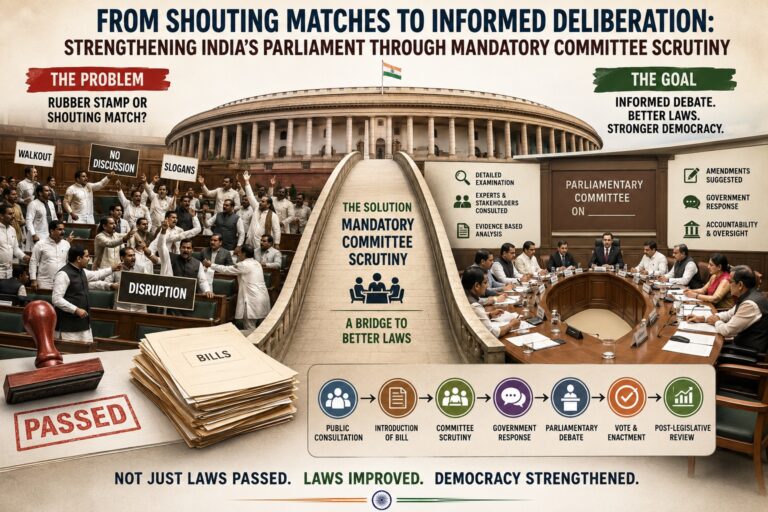
Parliamentary democracy is not simply a mechanism for converting an electoral majority into legislation. Its deeper purpose is to provide an institutional forum in which competing ideas are debated, the executive is scrutinised, legislation is examined and, through the interaction of government and Opposition, public policy is improved. The strength of a Parliament should therefore not be measured merely by the number of Bills it passes, but by the quality of deliberation that precedes their enactment.
It is in this context that the growing perception that Parliament is becoming either a “rubber stamp” or a “shouting match” deserves serious consideration. The description may be exaggerated, because Parliament continues to perform important legislative, financial and accountability functions, and its committees often undertake substantial work away from the television cameras. Nevertheless, the concern points towards a genuine institutional problem: the space between the government’s proposal and Parliament’s final vote is not always sufficiently occupied by systematic, evidence-based scrutiny.
Parliament: More than a Voting Machine
In a parliamentary democracy, the government necessarily enjoys the advantage of its majority. That is the essence of representative government. But an electoral majority should not mean that every legislative proposal of the government is automatically accepted as sound policy.
The Opposition’s constitutional and democratic role is not merely to oppose. It is to question, scrutinise, propose alternatives and expose weaknesses in government policy. Equally, the government’s responsibility is not simply to defeat Opposition amendments but to demonstrate that its legislation has survived meaningful scrutiny.
Parliament therefore performs a function that is greater than the arithmetic of majority and minority. It is a mechanism for converting political disagreement into informed collective judgement.
When parliamentary proceedings are repeatedly disrupted, this deliberative function suffers. But the opposite danger is equally serious: if legislation is passed with little substantive examination because the government possesses the numbers, Parliament risks becoming a body that merely ratifies executive decisions.
The real objective, therefore, should not be to create a Parliament without conflict. Democracy requires disagreement. The objective should be to transform disagreement into deliberation.
The Missing Institutional Bridge
This is where parliamentary committees become crucial.
The floor of the House is not always the ideal environment for examining technically complex legislation. Parliamentary debate is necessarily political and often constrained by time. Members may have limited opportunity to examine hundreds of pages of a Bill, assess its administrative implications, consult specialists or compare international experience.
A committee can perform precisely these functions.
A Bill sent to an appropriate committee can be examined clause by clause. Members can question government officials, invite experts and stakeholders, examine evidence, identify unintended consequences and suggest amendments. The committee can also provide an environment in which members from different political parties work together without the immediate pressures of floor politics.
The committee system can therefore serve as Parliament’s institutional quality-control mechanism.
This is why making committee scrutiny mandatory for Bills deserves serious consideration. The principle should be simple: a Bill proposed by the government should ordinarily not reach the final stage of parliamentary approval without first receiving structured examination by an appropriate parliamentary committee.
Such scrutiny would not mean that the committee acquires a veto over legislation. The elected government would retain the right to pursue its legislative programme, and Parliament would retain the final authority to accept or reject the Bill.
But the government should have to confront the arguments raised during scrutiny.
From Majority Rule to Deliberative Majority Rule
Mandatory committee scrutiny would introduce an important distinction between majority rule and deliberative majority rule.
In the first model, the government introduces legislation, the Opposition objects, political positions harden and the majority eventually determines the outcome through voting.
In the second, the government proposes legislation; the committee examines it; experts and stakeholders provide evidence; Opposition members identify weaknesses; amendments are considered; the government responds; and the House subsequently debates and votes.
The majority would still prevail if it has the numbers. But its decision would emerge after a more rigorous process of examination.
That is an important distinction. Democracy is not weakened merely because the majority ultimately wins; it is weakened when the majority has little institutional incentive to listen before it wins.
Should Committee Recommendations Be Binding?
Mandatory scrutiny should not necessarily mean that committee recommendations become binding upon the government. That could give an unelected or indirectly constituted committee an effective veto over the elected government’s legislative programme.
A better arrangement would be to require the government to provide a reasoned written response to significant recommendations made by the committee.
If the committee recommends deleting a provision, changing its language or introducing a safeguard and the government rejects that recommendation, the government should explain why. That response should accompany the Bill when it returns to the House.
This would create a healthy institutional relationship:
Committee scrutinises → Government responds → Parliament debates → Majority decides.
The committee would therefore have the power of persuasion and accountability rather than veto.
A Limited Exception for Emergencies
Mandatory scrutiny should also not become an inflexible procedural obstacle.
There may be circumstances in which legislation genuinely requires urgent passage—for example, an unforeseen national emergency or a situation in which delay would cause serious public harm. In such circumstances, the government could be permitted to bypass or abbreviate ordinary committee scrutiny.
But the exception should be narrowly defined, and the government should be required to explain to Parliament why normal scrutiny could not be followed.
The principle should therefore be mandatory scrutiny as the norm, exemption as the exception.
What India Could Learn from the US Congress
Such a reform would also give Indian Parliament something of what might be called a “congressional dimension”, without turning India into a congressional system.
The committee system occupies an extraordinarily important place in the United States Congress. Congressional committees examine legislation, conduct hearings, develop policy expertise and exercise extensive oversight of executive agencies. They provide Congress with an institutional mechanism through which legislation and government activity can be examined in considerable detail.
India could learn from this aspect of the American system without abandoning its parliamentary form of government.
The distinction is fundamental.
The United States operates under a system based on a relatively strong separation between the executive and legislature. India operates under a parliamentary system in which the executive is drawn from the legislature and depends upon its majority.
India therefore does not need to become America.
It needs to borrow an institutional strength from the American congressional experience and adapt it to the Indian parliamentary system.
In other words, India could strengthen the committee-based scrutiny characteristic of Congress while retaining the responsible-government principle of the parliamentary system.
From Shouting Match to Deliberative Forum
There is another important advantage.
Mandatory committee scrutiny could change the very nature of parliamentary confrontation.
Today, political disagreement often becomes visible through interruptions, slogans and adjournments. Such confrontation may occasionally be necessary to draw attention to an issue, but it cannot substitute for legislative scrutiny.
A committee provides an alternative channel for Opposition politics.
Instead of merely saying, “We oppose this Bill”, Opposition members can demonstrate why they oppose it. They can identify a defective clause, challenge an assumption, propose an alternative provision, question its financial consequences or demonstrate how it could affect particular sections of society.
This would make opposition more substantive.
The government, similarly, would have to defend its legislation with evidence rather than simply relying upon its numerical majority.
Thus, mandatory committee scrutiny could potentially transform the political culture from:
Government proposes → Opposition protests → Majority votes
to:
Government proposes → Committee scrutinises → Evidence is examined → Amendments are considered → Government responds → Parliament debates → Majority decides.
That is not the elimination of political conflict. It is the institutionalisation of productive conflict.
Parliament Should Become More Intelligent, Not Merely Quieter
It would therefore be a mistake to measure parliamentary reform simply by asking whether the number of disruptions has declined.
A completely quiet Parliament could be a weak Parliament if the Opposition has stopped challenging the government. Conversely, a noisy Parliament can sometimes be a vibrant democracy.
The more meaningful question is:
Does parliamentary disagreement ultimately improve legislation and strengthen executive accountability?
That should be the test.
The objective should not be to make Parliament quieter. It should be to make Parliament more deliberative, more informed and more consequential.
A Possible Reform Architecture
A strengthened legislative process could therefore follow a relatively simple sequence:
Public consultation → Introduction of Bill → Mandatory referral to appropriate committee → Evidence and expert consultation → Committee report → Government response → Detailed parliamentary debate → Vote → Post-legislative review.
Such a system would create multiple opportunities to identify defects before they become embedded in law.
It would also strengthen the connection between Parliament and society. Experts, professional bodies, civil-society organisations and affected citizens could contribute evidence through committee proceedings. Parliament would thereby become not merely a place where elected representatives speak to one another, but an institution that listens to society before legislating for it.
The Larger Democratic Principle
The debate about parliamentary committees ultimately raises a much larger question about the meaning of representative democracy.
An election gives a government the authority to govern. It does not give it a monopoly over wisdom.
Likewise, losing an election does not deprive the Opposition of its responsibility to scrutinise.
The genius of parliamentary democracy lies in creating an institutional relationship between the two: the government has the authority to decide, while Parliament has the responsibility to examine that decision before it becomes law.
Mandatory committee scrutiny could strengthen precisely this relationship.
It would ensure that a government’s legislative majority remains powerful without becoming unquestionable; that the Opposition remains adversarial without becoming merely obstructive; and that parliamentary debate becomes something more than a contest between competing political performances.
The ultimate purpose of Parliament should therefore be neither to rubber-stamp government nor to become a permanent shouting arena. It should be to subject political proposals to reasoned scrutiny and convert disagreement into better public policy.
India does not need to choose between the Westminster tradition and the congressional tradition. It can retain its parliamentary system while strengthening one of the most valuable institutional instruments developed within the congressional system—the powerful committee.
The reform can therefore be expressed in one simple proposition:
The majority should have the right to decide, but Parliament should have the institutional capacity to make the majority listen before it decides.
That may be one of the most important steps towards restoring Parliament’s original purpose: not merely to pass laws, but to make better laws through informed democratic deliberation.