
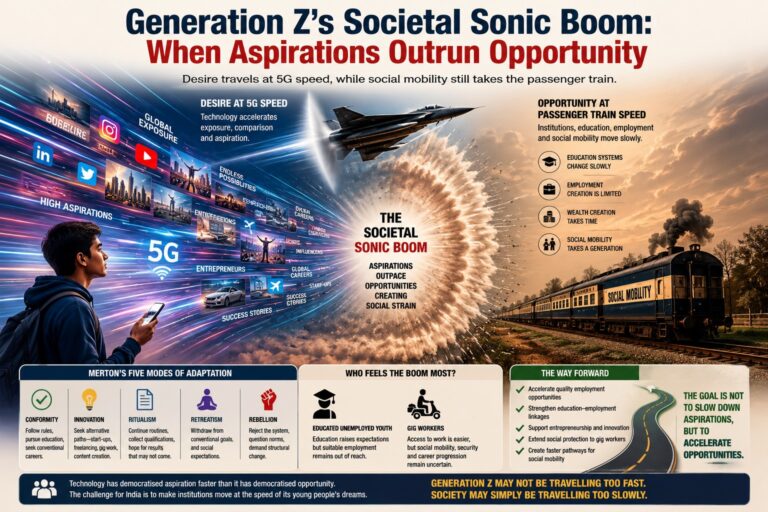
One of the most important contributions of Robert K. Merton to sociology was his attempt to explain how social structure shapes individual behaviour. His theory of social structure and anomie remains particularly relevant to understanding contemporary youth, including India’s Generation Z, gig workers and educated unemployed youth.
Merton built upon Durkheim’s concept of anomie but gave it a distinctive sociological interpretation. He argued that societies often encourage culturally approved goals—such as wealth, success, status and upward mobility—without ensuring that everyone has equal access to the legitimate means required to achieve them. When there is a widening gap between socially prescribed aspirations and institutionally available opportunities, individuals experience strain. Merton identified five possible modes of adaptation: conformity, innovation, ritualism, retreatism and rebellion.
This framework offers a powerful way of understanding the predicament of India’s Generation Z. Young Indians today have unprecedented exposure to possibilities and lifestyles that earlier generations could scarcely imagine. Yet their ability to convert these aspirations into economic and social mobility remains constrained by the slower-moving structures of education, employment and wealth creation. The result is a growing tension between what young people believe is possible and what their social environment enables them to achieve.
This tension can be captured in a simple observation:
“Desire travels at 5G speed, while social mobility still takes the passenger train.”
Technology has transformed the speed at which aspirations are created. Through smartphones, social media and global digital platforms, a young person can instantly observe the lifestyles of successful entrepreneurs, professionals, influencers and creators across the world. The reference group of Generation Z is no longer restricted to family, neighbourhood or even country. It has become global.
Yet social mobility has not accelerated at the same speed. A degree still requires years of study; professional experience takes time to accumulate; wealth creation is generally gradual; and movement from one socioeconomic position to another may take an entire generation. Thus, technology has dramatically accelerated the formation of aspirations, while the economic and institutional structures required to fulfil those aspirations remain comparatively slow.
This produces a profound contradiction. A young person can see the possibilities of a better life almost instantaneously, but may require years to acquire the education, employment, capital and social networks necessary to achieve it. The distance between aspiration and opportunity therefore becomes a source of frustration.
This contradiction is particularly acute among educated unemployed youth. Education raises expectations and creates the belief that qualifications will lead to employment, income, status and upward mobility. When suitable employment fails to materialise, the young person experiences not simply unemployment but a breakdown in the expected relationship between education and social advancement. The problem, therefore, cannot always be understood as an individual failure. It may reflect a structural mismatch between aspirations generated by society and opportunities provided by the economy.
The gig economy adds another dimension. Digital platforms have made it easier for young people to enter the labour market, but access to work does not necessarily translate into social mobility. A gig worker may earn an income while lacking employment security, predictable earnings, social protection and clear career progression. Technology has therefore accelerated access to employment without necessarily accelerating the journey towards economic security and upward mobility.
Merton’s framework becomes particularly useful here because the same structural strain can produce different responses. Some young people conform by continuing to pursue conventional careers and competitive examinations. Others innovate by entering entrepreneurship, freelancing, content creation or gig work. Some become ritualistic, continuing to acquire qualifications despite losing faith in their ability to produce mobility. Others withdraw from conventional aspirations, while some question the existing definition of success itself and demand structural change.
The problem, therefore, should not simply be described as Generation Z being impatient or unwilling to work hard. The deeper issue is that digital acceleration has collided with socioeconomic inertia. Information, communication, comparison and aspiration now move at extraordinary speed, while education systems, labour markets and social mobility continue to operate through much slower processes.
This brings us to the metaphor of the societal sonic boom.
A supersonic aircraft produces a sonic boom when it travels faster than the surrounding medium can accommodate smoothly. In a similar metaphorical sense, Generation Z’s aspirations have been accelerated by technology beyond the speed at which existing social institutions can respond. The resulting tension—the accumulated pressure between rapidly expanding aspirations and slowly expanding opportunities—can be understood as a societal sonic boom.
The metaphor should not, of course, be treated as a literal sociological law. Generation Z’s difficulties have many causes, including inequality, changing employment structures, housing costs, political uncertainty and changing social expectations. Nevertheless, the metaphor captures an important structural reality: technology has democratised aspiration faster than it has democratised opportunity.
The significance of Merton’s insight is therefore that it shifts the question from the individual to the social structure. Instead of asking only, “Why are young people dissatisfied?”, sociology asks a deeper question: “What happens when society teaches young people to aspire to success faster than its institutions can provide legitimate pathways to achieve it?”
For India, this question is particularly important. The challenge is not necessarily to tell Generation Z to lower its aspirations. If technology, education and global connectivity have legitimately expanded what young people can imagine, then the more constructive response is to expand the opportunities through which those aspirations can be realised.
The ultimate challenge, therefore, is to close the gap between aspiration and opportunity.
Generation Z may not be travelling too fast. Society may simply be travelling too slowly.