
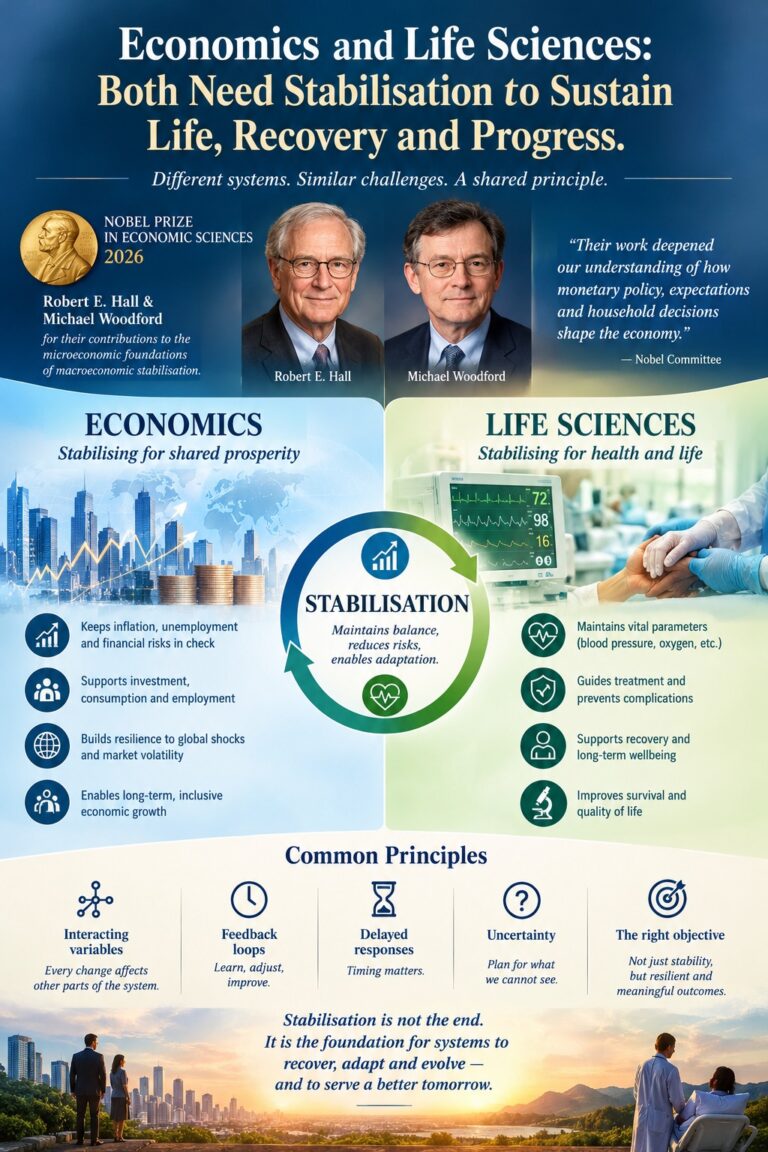
From economic crises to medical emergencies, the science of stabilisation offers a way to understand how complex systems preserve their functioning, recover from disturbances and continue to evolve.
Introduction: The Problem of Stability in a Changing World
The world is composed of complex systems whose existence depends on a delicate relationship between stability and change. An economy must withstand recessions, inflationary pressures and financial disruptions. A living organism must maintain blood pressure, oxygen supply, temperature and metabolic balance despite disease, injury and environmental stress. Although the nature of these systems differs considerably, both confront a fundamental problem: how can a system preserve its essential functions while responding to disturbances?
This question acquires particular significance when we consider the relationship between stabilisation and evolution. Stability does not necessarily mean remaining unchanged. Rather, it means retaining the capacity to function, adapt and develop despite changing circumstances. A healthy economy must be capable of restructuring itself as technologies, institutions and markets change. A living organism must adjust to changing physiological demands without losing the capacity to sustain life.
The idea that the stabilisation of vital parameters enables systems to perpetuate their dynamics and serve a meaningful social purpose therefore provides a promising starting point for interdisciplinary inquiry. It connects economics, physiology, engineering, systems science and the broader study of complex systems.
However, the relationship must be understood carefully. Similarities in mathematical structure do not imply that economic and biological systems operate through identical mechanisms. The value of the comparison lies in identifying shared principles while respecting the differences between the disciplines.
Economic Stabilisation: Preserving the Conditions for Collective Progress
An economy is not merely an aggregate of prices, incomes and production figures. It is a network of households, businesses, financial institutions and public authorities whose decisions continually influence one another. Consumption affects production, investment influences employment, and monetary policy affects borrowing costs and economic expectations.
When these relationships become severely disrupted, the economy may enter a recession, experience persistent inflation or encounter a financial crisis. Such disturbances can undermine employment, household security, productive investment and public welfare.
The work recognised by the 2026 Nobel Prize in Economic Sciences, awarded to Robert E. Hall and Michael Woodford for their contributions to the microeconomic foundations of macroeconomic stabilisation, is relevant to this problem. Their research helps explain how the decisions of households and firms interact with monetary and fiscal policy to influence economy-wide fluctuations.
The central lesson is that economic stabilisation requires more than reacting to an isolated indicator. Policymakers must understand the mechanisms connecting consumption, investment, expectations, prices and production. An interest-rate decision, for example, may influence borrowing and spending, but its effects depend on the prevailing economic conditions and what households and businesses expect to happen next.
Stabilisation policy consequently seeks to moderate damaging fluctuations without preventing the economy from adapting. Excessive inflation can undermine purchasing power, while an unnecessarily severe contraction can destroy employment and productive capacity. Appropriate intervention seeks to reduce these harms while preserving the conditions for sustainable economic activity.
Yet stabilisation has limits. A central bank cannot eliminate every supply shock, prevent every financial crisis or guarantee equitable prosperity. Economic stability is a necessary contributor to social welfare, not a sufficient condition for achieving it.
Biological Stabilisation: Preserving the Conditions for Life
A comparable problem exists in medicine, particularly when a patient experiences a critical illness.
The human body depends on the coordinated functioning of several physiological systems. Blood pressure supports circulation; respiration enables oxygen exchange; the cardiovascular system delivers oxygen and nutrients; and metabolic processes maintain the conditions required for cellular activity. These variables interact, and their significance depends on the condition of the patient as a whole.
Consider a patient experiencing dangerously low blood pressure. The immediate objective may be to restore adequate circulation and protect vital organs. But low blood pressure is a sign, not a complete diagnosis. Its cause might be severe fluid loss, infection, cardiac dysfunction or another condition. An intervention that is appropriate for one cause may be ineffective or harmful for another.
This illustrates a principle shared with economic policymaking: an abnormal measurement cannot be interpreted independently of the system producing it.
A clinician must consider the patient’s underlying condition, the relationships between physiological variables, the likely consequences of treatment and the possibility of unintended effects. The objective is not simply to force one number into a normal range. It is to restore or preserve clinically appropriate physiological functioning while treating the underlying cause.
Furthermore, stability in a living organism is dynamic. The body continually adjusts its responses to changing internal and external conditions. During illness, these compensatory mechanisms may become insufficient, and the patient may require medical intervention to restore balance.
Thus, physiological stabilisation is not the suppression of biological change. It is the preservation of the conditions under which biological functioning and recovery remain possible.
The Common Ground: Interacting Variables, Feedback and Delayed Responses
The comparison between economic and medical stabilisation becomes particularly useful when examined through systems theory.
First, both systems contain interacting variables. In economics, interest rates influence investment, consumption and inflation. In physiology, blood pressure, cardiac output, vascular resistance and circulating blood volume influence one another. An intervention directed at one variable can produce consequences elsewhere in the system.
Secondly, both systems involve feedback. Policymakers observe inflation, output and employment before adjusting economic policy. Clinicians monitor vital signs, laboratory results and organ function when evaluating treatment. The results of an intervention provide new information that may require subsequent adjustments.
Thirdly, interventions frequently have delayed consequences. Monetary policy can take considerable time to affect investment and inflation. Medical treatments can also have effects that develop over different timescales. Failure to account for these delays can lead to excessive or poorly timed intervention.
Finally, both systems operate under uncertainty. Economic policymakers cannot observe every relevant expectation or predict every external shock. Clinicians cannot measure every aspect of a patient’s physiological condition directly or know with certainty how a particular patient will respond to treatment.
These similarities suggest that mathematical approaches developed for one class of complex systems may offer useful insights for another. But such transfer requires more than an analogy: the underlying mechanisms must be identified, the model must be appropriately constructed, and its predictions must be tested.
From Economic Models to Medical Control Systems
If the objective is to develop a practical method for stabilising a patient’s vital parameters, control theory provides a particularly relevant mathematical foundation.
Control theory studies how interventions can guide a changing system towards a desired state despite disturbances and imperfect information. Its applications range from industrial processes and aircraft control to glucose regulation and medical devices.
A simplified medical control system contains three elements: the patient’s physiological state, the interventions applied and the measurements used to evaluate the response.
The patient’s underlying state may not be fully observable. A blood pressure reading, for instance, does not by itself reveal whether oxygen delivery to the tissues is adequate. A useful model must therefore combine measurements with knowledge of physiological mechanisms and the patient’s clinical context.
Model-predictive control offers one possible approach. It repeatedly uses available measurements to forecast how a system might respond to alternative interventions, selects an action within defined constraints and then updates its calculations as new information becomes available.
In medicine, such techniques have potential applications in areas including glucose management, ventilator control and selected aspects of cardiovascular support. Their use must nevertheless be based on application-specific evidence, clinical validation and appropriate safeguards.
Economic stabilisation models can contribute ideas about dynamic decision-making, uncertainty and the consequences of interventions over time. However, they cannot simply be transferred into medical practice. The physiology of a patient must determine the model’s causal structure, while clinical evidence must establish whether the resulting intervention is safe and effective.
The Critical Difference: Stability Is Not the Same as Optimality
The analogy also reveals a major danger: treating stabilisation as an end in itself.
An economy could display relatively stable prices while experiencing persistent unemployment, severe inequality or inadequate investment. Similarly, a patient’s individual vital signs could appear satisfactory while underlying organ dysfunction continues.
A system can therefore be stable in one measurable dimension and still be failing in a more important sense.
The appropriate objective is not to maximise stability indiscriminately. It is to preserve the variables and relationships essential to the system’s proper functioning. In economics, this requires considering output, employment, financial resilience and social welfare alongside inflation. In medicine, it requires evaluating the patient’s overall condition, organ function, complications and prospects for recovery rather than relying on a single measurement.
There is also a difference in the nature of the system’s purpose. Economic systems are shaped by human decisions, institutions, social priorities and competing interests. Biological systems are governed by physiological and evolutionary mechanisms, although medical decisions about treatment necessarily involve human values and ethical judgements.
Consequently, the meaning of a desirable outcome cannot be derived from mathematics alone. Models can clarify trade-offs, predict consequences and help compare alternatives, but the objectives they pursue must be established through appropriate scientific, ethical and social reasoning.
Stabilisation as a Condition for Evolution
The deeper significance of this discussion concerns the relationship between stability and change.
A system that cannot withstand ordinary disturbances may lose its capacity to function, adapt or develop. But a system that is made excessively rigid may also lose its ability to respond to new circumstances.
An economy needs sufficient stability for households to plan, businesses to invest and institutions to operate, yet it must remain capable of technological innovation, structural transformation and the reallocation of resources. A living organism needs physiological regulation, yet its survival also depends on adaptive responses to new conditions.
The relevant objective is therefore not absolute stability but resilient stability: the capacity to preserve essential functions while responding to disturbances and adapting to changing circumstances.
This perspective also clarifies the role of intervention. A successful intervention does not necessarily return every variable to its previous value. It may instead prevent a disturbance from becoming catastrophic, preserve essential functions and allow the system to move towards a viable new state.
In medicine, this may mean supporting organ function while treating the disease responsible for a crisis. In economics, it may mean limiting a recession’s damage while allowing necessary structural adjustments to proceed.
In both cases, stabilisation creates possibilities rather than guaranteeing outcomes. It preserves the conditions under which recovery and further development can occur.
The Social Purpose of Stabilisation
Why does this matter beyond the technical study of complex systems?
The answer lies in the relationship between system functioning and human welfare. Economic instability can deprive people of livelihoods, disrupt education, undermine public services and increase insecurity. Medical instability can threaten life, impair recovery and place enormous burdens on patients and families.
Stabilisation therefore has a social dimension. Its purpose is not merely to improve a graph, satisfy a numerical target or demonstrate the predictive power of a model. It is to protect the conditions necessary for people and communities to live, recover, participate and flourish.
Nevertheless, technical effectiveness must be distinguished from social justice. An economic policy may stabilise aggregate output without distributing its benefits fairly. A medical technology may improve a clinical outcome while remaining inaccessible to large sections of the population.
A meaningful assessment of stabilisation must therefore ask two questions: does the intervention improve the functioning of the system, and does that improvement serve a defensible human purpose?
This distinction is especially important when interdisciplinary models are developed. Mathematical sophistication is valuable only when accompanied by sound causal reasoning, empirical validation and attention to the consequences for the people affected.
Conclusion: A Shared Principle, Distinct Sciences
The stabilisation of vital parameters offers a powerful way to think about the persistence and evolution of complex systems. In economics, it concerns the management of fluctuations that threaten productive activity and social welfare. In medicine, it concerns the preservation of physiological functioning during illness and the creation of conditions favourable to recovery.
Both fields can benefit from studying interacting variables, feedback, delayed responses, uncertainty and the consequences of intervention. Systems theory and control theory provide tools for exploring these connections, while the findings of economics, physiology and clinical research determine how those tools should be applied in each domain.
The analogy must not obscure the differences between human institutions and biological mechanisms. Nor should stability be confused with the absence of change, or a favourable measurement with the achievement of a meaningful objective.
The central proposition is more precise: the capacity to stabilise essential functions can preserve a system’s ability to recover, adapt and evolve; the value of that stabilisation ultimately depends on the purposes it serves.
Whether the system is an economy confronting a crisis or a patient confronting a life-threatening illness, stabilisation is not the final destination. It is the means by which the possibility of a viable future is preserved.
That is the broader social and scientific significance of connecting the study of economic stabilisation with the life sciences: not that all complex systems are identical, but that understanding how they maintain essential functions may help us protect the conditions for human welfare, recovery and continued development.