
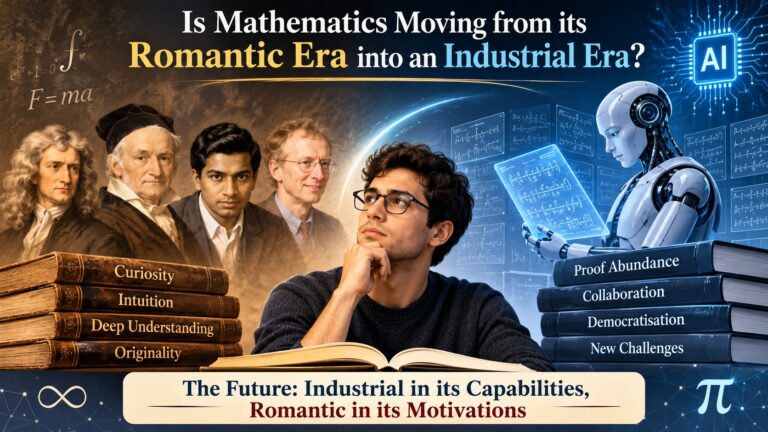
Is mathematics moving from its romantic era into an industrial era?
Terence Tao’s observation that mathematics is moving from a romantic era into an industrial one is a remarkably insightful description of what AI may do to research. It also raises a larger question than whether AI can solve hard problems: is mathematics primarily the pursuit of mathematical knowledge, or also a human intellectual activity whose value lies in the process of discovering it?
Tao’s concern is that AI is making proofs increasingly abundant, so that the mathematician’s role may shift from discovering proofs to producing, organising and verifying them. In his October 2026 Numberphile interview he contrasted the traditional image of Andrew Wiles spending years on Fermat’s Last Theorem with a future in which research resembles large-scale industrial collaboration. He also acknowledged that the romantic era had disadvantages, particularly hero worship and unequal recognition. The diagnosis is broadly right, but several of its assumptions deserve challenge.
The romantic era was not necessarily the golden era
The romantic image rests on individual genius, curiosity and extraordinary personal achievement: Newton developing calculus, Gauss transforming number theory, Ramanujan producing astonishing identities, Wiles proving Fermat’s Last Theorem. These stories show something valuable, the capacity of a single human mind to uncover unexpected relationships.
But mathematics was never entirely an individual pursuit. Newton and Leibniz built on centuries of earlier work. Ramanujan’s work benefited from his collaboration with G. H. Hardy. Wiles’s proof depended on decades of developments by many mathematicians, and its final repair involved Richard Taylor. The lone genius is often the visible face of a much larger intellectual ecosystem. Industrialisation might therefore not destroy the collaborative character of mathematics but simply make it more visible. The romantic era celebrated the individual who completed the proof; the industrial era may celebrate the ecosystem that made the proof possible.
Producing proofs is not producing understanding
This is Tao’s strongest argument. There is a substantial difference between establishing that a proposition is true, understanding why it is true, and understanding the deeper relationships that make it true. An AI system might produce a valid proof with thousands of intermediate propositions, and a formal verifier might confirm every step, yet a mathematician may still need months to grasp its conceptual structure.
This is the problem of proof abundance, or an intellectual digestion problem. Imagine a million proofs and too little human capacity to understand their significance: mathematics would not have advanced a million times. A proof is an established result, but understanding it may reveal connections, generalisations and new research questions.
Industrialisation may democratise discovery
The romantic era was also an era of high barriers: years of specialised education, access to established research communities, guidance from influential mathematicians, familiarity with an enormous literature, and considerable time and institutional resources. AI could lower some of them. A researcher who is not an expert in algebraic geometry might use AI to learn unfamiliar concepts, explore conjectures and develop preliminary proofs, and an independent mathematician at a smaller institution might gain capabilities once reserved for well-resourced groups.
There is a qualification. Access to computing, high-quality models, supervision and academic recognition may become new sources of inequality. Industrialisation could democratise mathematical production while concentrating control over the tools of production.
The analogy with the Industrial Revolution is incomplete
Machines of the Industrial Revolution replaced or transformed physical labour, but mathematics is not simply a production activity. Its value is not the number of theorems per unit of time. Consider one mathematician who establishes 100 results with AI without understanding their connections, and another who establishes one result that reveals a new structure and opens a research direction. Which contributed more? The count alone cannot say. Theorems are not interchangeable products: their significance depends on conceptual depth, relationship to existing knowledge and the questions they make possible. The industrial model describes the scaling of research well, but poorly if it implies that progress equals volume of output.
The danger of turning research into an optimisation problem
If AI makes proofs easy to generate, institutions may begin rewarding the number of problems solved, papers published and results produced, a mathematical equivalent of industrial productivity targets. Researchers would then ask not what important question to investigate, but which problem AI can solve most efficiently so a result can be published. Tao has raised exactly these concerns about publication incentives, premature reporting of AI-generated results, and the pull towards easily generated results over deeper understanding.
The answer is not to resist AI but to change how contributions are evaluated: not merely whether a result establishes a proposition, but whether it provides meaningful understanding, useful generalisations or new conceptual tools.
What happens to the joy of discovery?
Suppose an AI proves a theorem a mathematician has pursued for ten years. The result is valuable, but something may be lost: struggling with a hard problem develops intuition, discipline and the ability to see hidden structure, and sometimes the journey is the greater reward.
Yet difficulty is not valuable merely because it is difficult. If AI removes months of tedious calculation, repetitive verification or routine algebra, mathematicians should welcome it. We do not ask astronomers to compute planetary positions by hand to preserve the romance of astronomy. The challenge is to distinguish intellectual struggle that builds understanding from mechanical effort that merely consumes time.
From proof scarcity to proof abundance
A better description than romantic versus industrial may be a move from an era of proof scarcity to one of proof abundance. In the old environment, great intellectual resources went into finding a proof. In the new one, the scarce resources become identifying important problems, understanding the significance of solutions, judging whether a result generalises, connecting discoveries across disciplines, and establishing the reliability of AI-generated results. The bottleneck shifts from proof production to interpretation. This fits Tao’s October 2026 Nature essay, which calls for a new Maths 2.0 that places human understanding at the centre of research.
What mathematics should preserve from its romantic era
| What should change | What should be preserved |
| Mechanical calculations | Mathematical intuition |
| Routine proof verification | Conceptual understanding |
| Repetitive problem-solving | Curiosity and exploration |
| Individual isolation | Intellectual independence |
| Productivity-based recognition | Originality and depth of thought |
There is an educational implication too. Tao argues that students should learn traditional mathematical reasoning before depending on AI, just as children learn arithmetic before using calculators. That can go further: students should learn not only how to reach an answer but why a problem is interesting, how to formulate a conjecture, and how to question an apparently convincing result. Otherwise we risk people who can operate sophisticated systems without being able to think mathematically.
Assessment
The observation is broadly sound, but the transition need not mean the end of something intellectually superior. The romantic era had hero worship, unequal access, slow dissemination and duplicated effort; the industrial era may overcome some of these while introducing proof without understanding, excessive dependence on automated reasoning, concentrated technological resources and the commodification of academic achievement. Mathematics should not choose between its romantic and industrial identities but combine their strengths: industrial in its capabilities, romantic in its motivations. AI should help explore more possibilities, establish more results and overcome mechanical limits, while human curiosity decides which questions are worth asking and why the answers matter.
There is a distinction between the production of knowledge and the pursuit of knowledge. AI may make production extraordinarily efficient without making the pursuit less meaningful. If technology lets us explore a thousand galaxies instead of one, the excitement of astronomy expands rather than vanishes; likewise, if AI lets mathematicians investigate thousands of previously inaccessible structures, the frontier grows. Industrialisation should eliminate the scarcity of mathematical opportunities, not the human curiosity that makes them worth pursuing. The real question is whether our capacity to understand, appreciate and find meaning in theorems can keep pace with our capacity to produce them.