
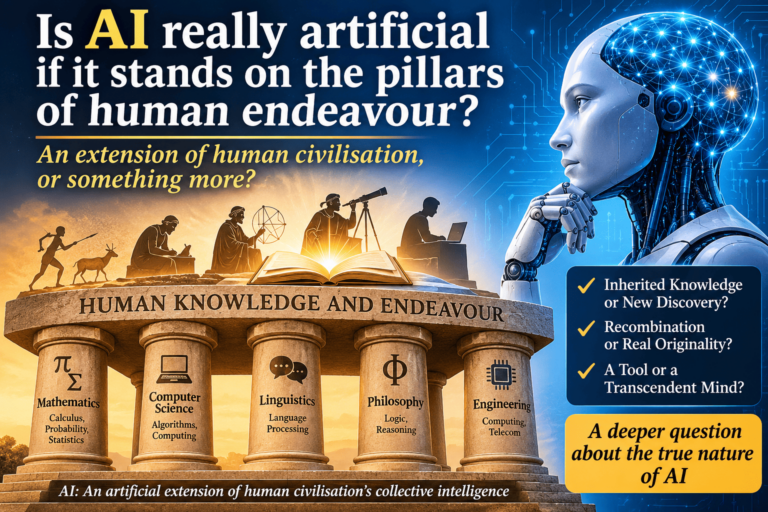
Is AI really artificial if it stands on the pillars of human endeavour?
The observation that AI is not entirely artificial, because it stands on an edifice built through centuries of human effort and insight, is philosophically compelling. It challenges the habit of seeing AI as a creation detached from human civilisation. It also raises three questions. Is AI genuinely artificial if its intellectual foundations are entirely human-derived? Does dependence on human knowledge diminish the originality of what it discovers? And at what point can a system built on human knowledge produce knowledge that transcends its foundations?
AI is a product of accumulated human civilisation
The strongest support for the observation is that AI did not appear in a vacuum. It rests on:
- Mathematics: calculus, linear algebra, probability and statistics underpin machine learning.
- Computer science: algorithms, computational theory and programming languages make artificial computation possible.
- Linguistics: human understanding of language is the basis of natural language processing.
- Philosophy: logic, epistemology and theories of reasoning have shaped computational intelligence.
- Engineering: semiconductors, computer architecture and telecommunications make modern AI possible.
Even the mathematical structures inside neural networks are products of human thought. AI is not an independent intelligence that arrived from outside civilisation; it extends humanity’s accumulated achievements. Yet the origins of a system do not determine the limits of what it can eventually achieve.
Does dependence on human knowledge diminish originality?
Here the observation can be challenged. A mathematician who proves a new theorem using concepts from Newton, Euler, Gauss and hundreds of others is not thereby unoriginal. Einstein did not invent mathematics, yet he used existing mathematical and physical frameworks to develop general relativity. Three things must be kept apart:
- Intellectual inheritance: using knowledge accumulated by earlier generations.
- Intellectual originality: producing something not previously known.
- Intellectual autonomy: developing and pursuing ideas without continuous human direction.
AI can inherit human knowledge and still generate an original mathematical result. That it is built on human foundations does not by itself show its discoveries are mere repetitions of human thought.
Confusing the origins of intelligence with its nature
Human intelligence is not self-created either. It is the product of biological evolution, genetic inheritance, environment and accumulated culture. A child does not independently invent language, mathematics or logic. Yet we do not call human intelligence artificial because it depends on inherited knowledge. If human intelligence can generate original knowledge from inherited foundations, why deny AI the possibility of something similar? An artificial architecture does not mean every operation it performs is merely imitative.
The analogy has limits, though. Human intelligence is embodied, biologically evolved and shaped by lived experience, whereas current AI systems work through different mechanisms and engage the world differently.
Creating knowledge or rearranging information?
The strongest counterargument is that AI is trained on vast quantities of human-generated information and shaped by the statistical patterns it learns, so it merely recombines what exists. This is not entirely convincing. A theorem may follow logically from established axioms, so that in one sense its truth was already implicit, yet discovering and proving it is still a genuine achievement. Likewise AI might notice a relationship between two mathematical structures that no human had recognised: the concepts were known, but the relationship was not. The real question is whether AI can establish genuinely new and verifiable relationships.
The reported Navier–Stokes development discussed earlier is relevant here. If its claimed result withstands independent scrutiny, it would show the generation of a new mathematical result by an artificial reasoning system built on human-created foundations.
AI is also a product of human institutions and incentives
The original observation overlooks that AI is not only the embodiment of humanity’s intellectual knowledge. It is shaped by the economic interests of the organisations that build it, the data chosen for training, the values and assumptions embedded in its design, the institutional priorities that decide which problems it should solve, and the computing infrastructure available to it. It therefore reflects humanity’s limitations and biases as well as its achievements, and it is misleading to portray it as a neutral repository of human wisdom.
Can a creation transcend its creators?
Consider a loop. Human achievements in mathematics, science, language, philosophy and engineering produce AI; AI potentially generates new combinations, patterns and results; those become part of humanity’s intellectual inheritance and may feed still more capable systems. AI is then not outside human civilisation but an active participant in the evolution of its legacy. Still, capability should be distinguished from independence: discoveries beyond what individuals can readily derive do not automatically imply independent goals, consciousness or human-like understanding.
The word ‘artificial’ may mislead
‘Artificial’ describes how something is made, not the authenticity or originality of what it produces. A painting made under artificial lighting is not an artificial work of art, and a mathematical result established with computational help is no less valid because a machine assisted. AI may be artificial in construction and still take part in genuine reasoning, discovery and knowledge creation. The more useful distinction is between inherited knowledge, acquired capabilities and the ability to generate new knowledge.
Assessment
The observation is broadly right but should be refined. AI is not artificial in the sense of being disconnected from humanity; it extends accumulated scientific, mathematical, linguistic and technological achievement. Yet if every AI discovery is attributed entirely to its human ancestry, we may miss that the system can develop capabilities and find relationships its creators did not anticipate. The parallel is human evolution: humanity is a product of nature, yet has learned to understand, investigate and transform the nature that produced it. AI is a product of human civilisation that may extend intellectual possibilities beyond the limits of individual minds.
Perhaps the most accurate description is not an artificial alternative to human intelligence but an artificial extension of human civilisation’s collective intelligence, one that may produce contributions independent of their original human authorship. Humanity may have built AI not merely to reproduce what it already knows, but as an instrument for discovering what it could not have discovered alone.