
Introduction
Few ethical ideas have travelled such a remarkable historical distance as ahiṃsā, usually translated as non-violence or non-harming. What began within the religious and philosophical traditions of ancient India as a question of how human beings ought to conduct themselves towards other living beings eventually acquired a much wider political meaning. In the twentieth century, Mahatma Gandhi transformed non-violence into satyagraha, a method of organised resistance to injustice. His experiments subsequently influenced movements far beyond India, most famously the American civil-rights movement associated with Martin Luther King Jr.
It is tempting to describe this history as a simple chain:
Buddha and Mahavira → Ashoka → Gandhi → Martin Luther King Jr. → global civil-rights movements.
That formulation captures something important, but it is historically too neat. Ahiṃsā was not invented by Buddha or Mahavira; Buddhist and Jain traditions developed it in distinctive and systematic ways within a much wider Indian intellectual environment. Ashoka did not create the idea either, but his inscriptions provide unusually important evidence of a ruler incorporating moral restraint and welfare into imperial governance. Gandhi then made a further transformation by turning non-violence into an organised method of confronting political power.
The story is therefore less a straight line than an intellectual evolution in which an ethical principle repeatedly acquired new meanings in new historical circumstances.
The Ancient Indian Foundations of Ahiṃsā
The first caution concerns the claim that Buddha was the originator of ahiṃsā. There is no good historical basis for such a simple attribution.
The idea of avoiding harm existed within the wider Indian religious and philosophical environment, and its meaning developed across several traditions. Jainism made ahiṃsā exceptionally central to its ethical system. Jain philosophy connects non-violence with its conception of living beings, karma and liberation, and requires particularly rigorous forms of restraint from monastics.
Buddhism likewise placed non-killing, compassion and loving-kindness at the centre of ethical discipline. Buddhist ethics links violence with suffering, hatred and harmful mental states. The Dhammapada, for example, uses the recognition that all beings fear death as a basis for the injunction against killing.
The distinction is important. Jainism and Buddhism did not simply invent an idea out of nothing; they participated in and substantially reshaped a broader Indian ethical conversation about violence, sacrifice, suffering, self-control and liberation.
Indeed, the interaction between these traditions and Brahmanical traditions was historically significant. Some Hindu philosophical traditions developed increasingly elaborate conceptions of non-harm, while Hindu literature also retained a powerful recognition of legitimate violence in contexts such as warfare and the duties of kingship. The resulting Indian intellectual tradition therefore contains both a strong ethic of non-harming and a sophisticated debate about when, if ever, violence can be justified.
This complexity matters because ahiṃsā should not be equated automatically with modern pacifism.
Buddha and Mahavira: Compassion and Radical Non-Harming
Buddha and Mahavira belong to roughly the same broad intellectual period of ancient India, although Jain tradition understands Mahavira as the last of a succession of Jinas rather than as the founder of Jainism in an absolute sense.
The Buddhist approach emphasised the reduction of suffering, compassion and purification of the mind. Jainism developed an even more rigorous conception in which harm could be physical, verbal or mental, direct or indirect. Jain ethical reasoning therefore extended responsibility considerably beyond the simple prohibition of physically killing another person.
Buddhist ethics also does not amount to a completely uncomplicated doctrine of pacifism. Buddhist texts generally regard war and violence as morally problematic, but Buddhist societies historically have sometimes accepted warfare and political coercion. Scholarly discussions therefore distinguish the normative Buddhist ideal of compassion and non-harming from the historical conduct of Buddhist states and societies.
The important historical achievement of these traditions was consequently not simply the proposition “do not kill”. It was the development of an ethical worldview in which the suffering of another being became morally relevant to one’s own conduct.
That was an important foundation for later developments.
Ashoka: From Personal Ethics to the Ethics of Kingship
The reign of Emperor Ashoka represents a fascinating next stage.
Ashoka’s importance does not lie in inventing ahiṃsā. Rather, it lies in the extraordinary evidence that survives concerning his attempt to make dhamma part of imperial governance.
The Kalinga war became the defining reference point of his later inscriptions. Ashoka expressed remorse over the suffering caused by conquest and promoted what he called “conquest by dhamma” rather than conquest through military force.
Yet it would be misleading to describe Ashoka as an absolute pacifist. His conception of dhamma was broader than non-violence and included moral conduct, compassion, welfare, tolerance and restraint. Nor did the Mauryan state cease to possess coercive authority.
Ashoka therefore represents an important conceptual transition:
non-harming as individual ethical discipline → moral restraint as an element of kingship and governance.
This is one of the earliest and most important historical examples of an Indian ethical tradition being brought into an explicit conversation with political authority.
From Ethical Principle to Political Philosophy
For many centuries, ahiṃsā remained principally an ethical and spiritual ideal. The revolutionary modern transformation came with Mahatma Gandhi.
Gandhi did not merely tell individuals not to hurt others. He asked a much more difficult political question:
Can an oppressed population resist an unjust power without reproducing the violence of that power?
His answer was satyagraha—literally associated with adherence to truth or truth-force.
Gandhi’s political non-violence was therefore not simply passive refusal to fight. It involved non-cooperation, civil disobedience, boycott, constructive work, personal discipline and willingness to accept suffering without deliberately inflicting suffering on the opponent.
This represented a major conceptual transformation:
Ahiṃsā → Satyagraha → organised non-violent resistance.
Modern philosophical scholarship similarly identifies Gandhi as one of the principal figures who developed active non-violent action as a political method rather than merely a personal ethic.
Gandhi Was Not Simply a Product of One Tradition
It would nevertheless be misleading to explain Gandhi’s philosophy solely through Buddha, Mahavira or even ancient Indian thought.
Gandhi’s intellectual development involved several streams. Indian religious traditions were fundamental, but he also encountered Leo Tolstoy, John Ruskin, Henry David Thoreau and Christian teachings, among others.
Tolstoy was particularly important.
Tolstoy’s doctrine of the law of love and his criticism of violence, coercive institutions and state power resonated strongly with Gandhi. Gandhi’s correspondence with Tolstoy in 1910 and the establishment of Tolstoy Farm in South Africa demonstrate that the relationship was more than an incidental intellectual encounter.
But describing Tolstoy as Gandhi’s “mentor” would go too far. Gandhi’s experiments with political resistance had already begun before their correspondence. Tolstoy therefore should be understood as a major intellectual influence and interlocutor who helped Gandhi clarify and deepen ideas he was already developing, rather than as the originator of Gandhi’s non-violence.
The relationship is better represented as:
Indian ahiṃsā + Gandhi’s spiritual development + Tolstoy’s law of love + Ruskin + Thoreau + experience in South Africa → Gandhian satyagraha.
The Great Transformation: From National Liberation to Civil Rights
Gandhi’s most significant international legacy came when his method was adapted to struggles that were very different from India’s anti-colonial movement.
Martin Luther King Jr.
The connection between Gandhi and Martin Luther King Jr. is particularly well documented.
King first encountered non-violence through several intellectual sources, including Henry David Thoreau. He subsequently learned about Gandhi’s movement and came to regard Gandhian non-violent resistance as the practical method he had been seeking. During the Montgomery Bus Boycott, King began applying those principles directly. He later travelled to India in 1959, where his engagement with Gandhi’s legacy deepened further.
King’s synthesis was not simply Indian. He combined Christian agape—the ethic of love—with Gandhian non-violent direct action.
In King’s formulation, therefore:
Christian love + Gandhian method → non-violent civil-rights resistance.
This represents one of the strongest documented examples of the transmission of Gandhian non-violence into another civil-rights tradition.
The Montgomery Bus Boycott, Birmingham campaign, Freedom Rides, sit-ins, marches and voting-rights campaigns demonstrated how non-violent resistance could challenge racial segregation and exclusion within a constitutional democracy.
India, the United States and South Africa: Three Different Struggles
The modern history of civil rights cannot, however, be reduced to a single Gandhian model.
In India, the central struggle included caste discrimination, untouchability, social exclusion and equal citizenship. The Constitution that came into force in 1950 combined formal equality with specific constitutional measures addressing historically disadvantaged communities.
In the United States, the principal historical trajectory ran from slavery through Reconstruction-era constitutional amendments, segregation and disenfranchisement to the modern civil-rights movement. The Brown v. Board of Education decision in 1954, the Civil Rights Act of 1964 and Voting Rights Act of 1965 represented major legal milestones.
In South Africa, apartheid constituted a highly institutionalised racial order. The anti-apartheid struggle initially contained substantial non-violent resistance, but its history demonstrates one of the limitations of treating every liberation movement as simply Gandhian.
Mandela: Why the South African Story Is More Complicated
Nelson Mandela and the African National Congress initially participated in non-violent resistance. But the trajectory changed dramatically following the Sharpeville massacre in 1960 and the subsequent banning of the ANC and PAC.
The ANC established Umkhonto we Sizwe (MK) in 1961 and adopted sabotage and armed struggle. South African historical sources document this transition and Mandela’s role in the creation of MK.
This makes Mandela fundamentally different from King as an example of Gandhian non-violence.
Mandela’s historical trajectory is better represented as:
non-violent protest → severe repression → armed resistance → imprisonment → negotiation → democratic transition.
The South African case therefore demonstrates that the global history of resistance cannot be understood simply as the progressive spread of ahimsa. Rather, different movements responded differently to their institutional and political circumstances.
What, Then, Is the Relationship Between Ahimsa and Modern Civil Rights?
The strongest historical proposition is not:
“Buddha and Mahavira created modern civil-rights movements.”
Nor is it:
“All modern civil-rights movements are descendants of Indian ahimsa.”
The more defensible proposition is:
Buddhist and Jain traditions were among the major Indian traditions that developed non-harming and compassion into systematic ethical principles. These ideas became part of a broader Indian intellectual inheritance. Gandhi reinterpreted and transformed this inheritance into satyagraha, an organised method of political resistance. That method subsequently influenced some major twentieth-century movements, most clearly Martin Luther King Jr.’s American civil-rights movement.
This distinction between inheritance, transformation and direct influence is essential.
There is a strong historical connection between Gandhi and King. There is a much more indirect connection between Buddha or Mahavira and King.
From Non-Violence to Human Rights
The evolution becomes even more interesting when we move from civil resistance to modern human-rights philosophy.
Ahiṃsā begins with a moral question:
“How should I treat another living being?”
Gandhian satyagraha converts this into a political question:
“How should I resist injustice without becoming an agent of violence myself?”
Modern civil-rights movements then broaden the question:
“How can people denied equal citizenship challenge institutions without reproducing systems of domination?”
Human-rights law takes the principle into another domain:
“What limits should be placed upon the power of the state over the individual?”
This helps explain why non-violence, dignity, equality and the right to life frequently appear in modern human-rights discourse even though they do not all originate from the same historical tradition.
Does the Abolition of the Death Penalty Come from Ahimsa?
This is another area where the connection is suggestive but should not be overstated.
Ahiṃsā provides an obvious ethical argument against capital punishment:
If deliberate killing is morally objectionable, why should the state acquire the authority to deliberately take a person’s life?
But modern abolitionism has multiple intellectual roots. Enlightenment thinkers such as Cesare Beccaria developed arguments concerning punishment, proportionality and the limits of state power independently of Indian ahiṃsā.
Modern abolitionist arguments also involve judicial error, human rights, discrimination, deterrence, rehabilitation and constitutional limitations on state authority.
There has nevertheless been a remarkable global movement away from capital punishment. By the end of 2025, Amnesty International recorded 113 countries as fully abolitionist and 145 as abolitionist in law or practice, although executions continued in 17 countries in 2025.
It would therefore be historically unjustified to say that the abolition of the death penalty originated in ahimsa. A more defensible observation is that the moral intuition behind ahiṃsā—that deliberately taking life requires profound justification—is compatible with, and can reinforce, modern abolitionist reasoning.
Ahiṃsā Is Not the Same as Pacifism
Another important distinction is between ahiṃsā, non-violence and pacifism.
Ahiṃsā is primarily an ethical principle of non-harming.
Pacifism is a broader philosophical position concerning violence, war and coercion.
Non-violent resistance is a political strategy.
These concepts overlap but are not identical.
Buddhist ethics, for example, strongly condemns killing and violence, yet historical Buddhist societies have not uniformly rejected warfare. Jainism developed an exceptionally rigorous doctrine of non-harming, while Gandhi transformed non-violence into political action. Modern civil-rights movements then selectively adapted aspects of that political method.
Thus:
Ahiṃsā ≠ pacifism ≠ passive resistance ≠ satyagraha.
Understanding these distinctions prevents the historical story from becoming romanticised.
The Deeper Idea: From Avoiding Harm to Confronting Injustice
Perhaps the most profound transformation in this entire history is that the meaning of non-violence changed from what one refuses to do into what one actively does.
At one level:
“I will not kill.”
At another:
“I will not respond to violence with violence.”
At Gandhi’s level:
“I will actively resist injustice while refusing to hate or physically harm the opponent.”
At King’s level:
“I will use organised non-violent action to challenge a system of racial discrimination while attempting to preserve the possibility of reconciliation.”
This is why Gandhian non-violence should not be confused with passivity.
The Stanford King Institute describes King’s understanding of nonviolent resistance as a courageous confrontation of injustice through love, and records King’s view that Gandhi had supplied him with a method for social reform.
A More Accurate Intellectual Genealogy
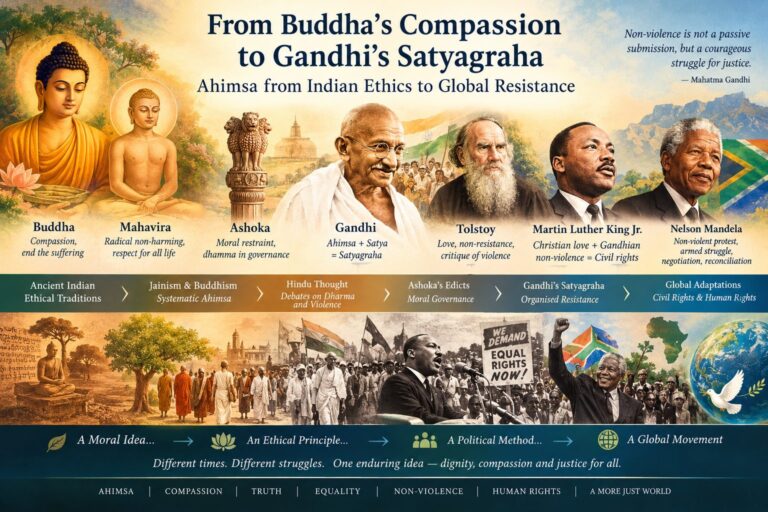
The entire historical development can therefore be represented as a series of transformations:
Ancient Indian ethical thought
↓
Ahiṃsā as non-harming
↓
Jainism — radical and systematic non-violence
↓
Buddhism — compassion, loving-kindness and rejection of killing
↓
Hindu philosophical and epic traditions — ahiṃsā alongside debates about dharma and legitimate violence
↓
Ashoka — moral restraint and dhamma incorporated into kingship
↓
Later Indian ethical traditions
↓
Gandhi — ahiṃsā + satya → satyagraha
↓
Tolstoy and other global intellectual influences reinforce Gandhi’s formulation
↓
Martin Luther King Jr. — Gandhian method + Christian agape
↓
American civil-rights movement
↓
International adaptation of non-violent resistance
Alongside this principal line runs a second, more complicated trajectory:
Gandhian influence + African political traditions + anti-colonial nationalism + repression + armed struggle + negotiation → South African liberation and democratic transition.
This second trajectory is why Mandela cannot simply be placed as the next “Gandhian” after King.
The Historical Achievement of Gandhi
Gandhi’s distinctive contribution, therefore, was not that he invented non-violence.
Nor was it that he simply reproduced the teachings of Buddha, Mahavira or Tolstoy.
His distinctive contribution was synthesis and political experimentation.
He brought together:
- the Indian ethical inheritance of ahiṃsā;
- truth as a moral principle;
- self-discipline;
- voluntary suffering;
- non-cooperation;
- civil disobedience;
- constructive social work;
- religious pluralism;
- and the practical organisation of mass movements.
He then tested these ideas against actual political conflicts.
That transformation—from personal morality to organised political action—is arguably the most important bridge between ancient Indian ethics and modern global resistance.
Conclusion: From Compassion to Resistance
The journey from ancient Indian ahiṃsā to modern civil-rights movements should neither be dismissed as a romantic civilisational narrative nor reduced to a simplistic chain of influence.
Buddhist and Jain traditions made non-harming, compassion and restraint exceptionally important components of Indian ethical thought. Other Indian traditions participated in the same long conversation, sometimes reinforcing ahiṃsā and sometimes debating it against concepts of duty, kingship and warfare. Ashoka provides an early and remarkable example of moral restraint being incorporated into imperial governance.
Gandhi then performed a different kind of transformation. He converted non-violence from primarily an ethical and spiritual principle into a method of confronting political injustice. Tolstoy’s philosophy of love and non-resistance strengthened aspects of this development, but Gandhi’s philosophy cannot be reduced to Tolstoy or to any single predecessor.
King subsequently demonstrated how Gandhian non-violence could be adapted to a struggle for racial equality in the United States. His own writings explicitly acknowledge Gandhi’s influence and describe the synthesis of Christian love with Gandhian non-violence.
Mandela’s experience provides a different lesson: the history of liberation movements cannot be reduced to non-violence alone. The South African struggle moved through non-violent protest, repression, armed resistance and ultimately negotiation and constitutional democracy.
The deepest historical continuity is therefore not a simple succession of personalities. It is the progressive transformation of a moral question:
How can human beings refuse to inflict unnecessary suffering?
became
How can injustice be resisted without reproducing violence?
and eventually:
How can political power be challenged while preserving human dignity, equality and the possibility of reconciliation?
That is the journey from Buddha’s compassion to Gandhi’s satyagraha—and from Indian ethics to a global repertoire of resistance.