History

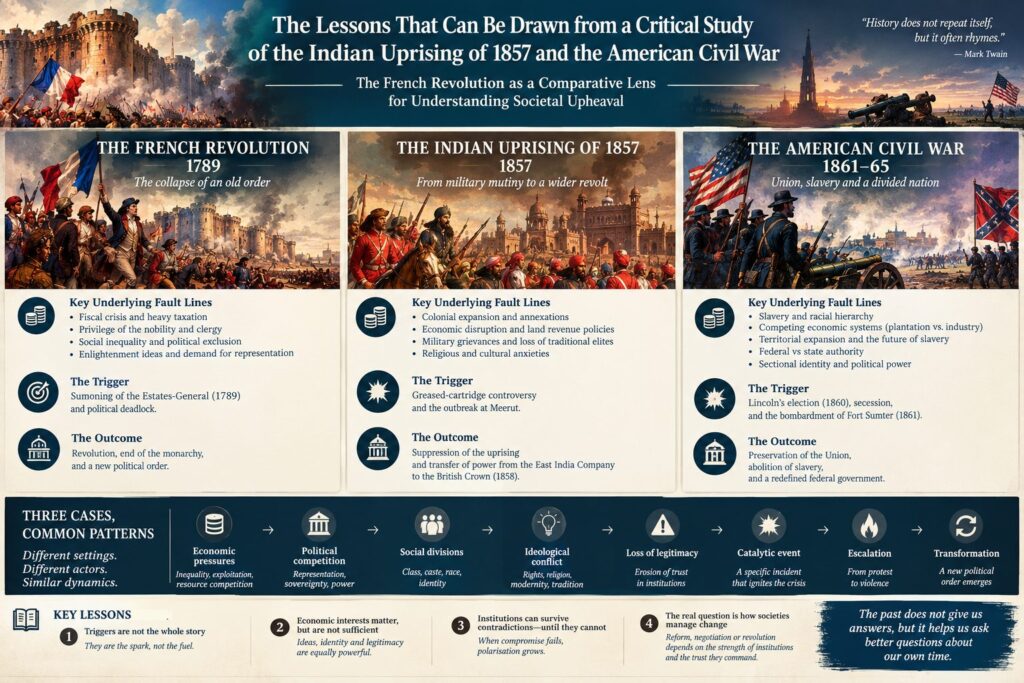
The French Revolution as a Comparative Lens for Understanding Societal Upheaval:The Lessons That Can Be Drawn from a Critical Study of the Indian Uprising of 1857 and the American Civil War

History contains moments when societies appear to change suddenly. A revolt begins in one place, a government loses authority, a political disagreement becomes violent, or a military confrontation develops into a much larger conflict. Yet major upheavals rarely emerge from a single incident. Behind the visible explosion usually lies a longer accumulation of economic pressures, […]
The French Revolution as a Comparative Lens for Understanding Societal Upheaval:The Lessons That Can Be Drawn from a Critical Study of the Indian Uprising of 1857 and the American Civil War Read More »

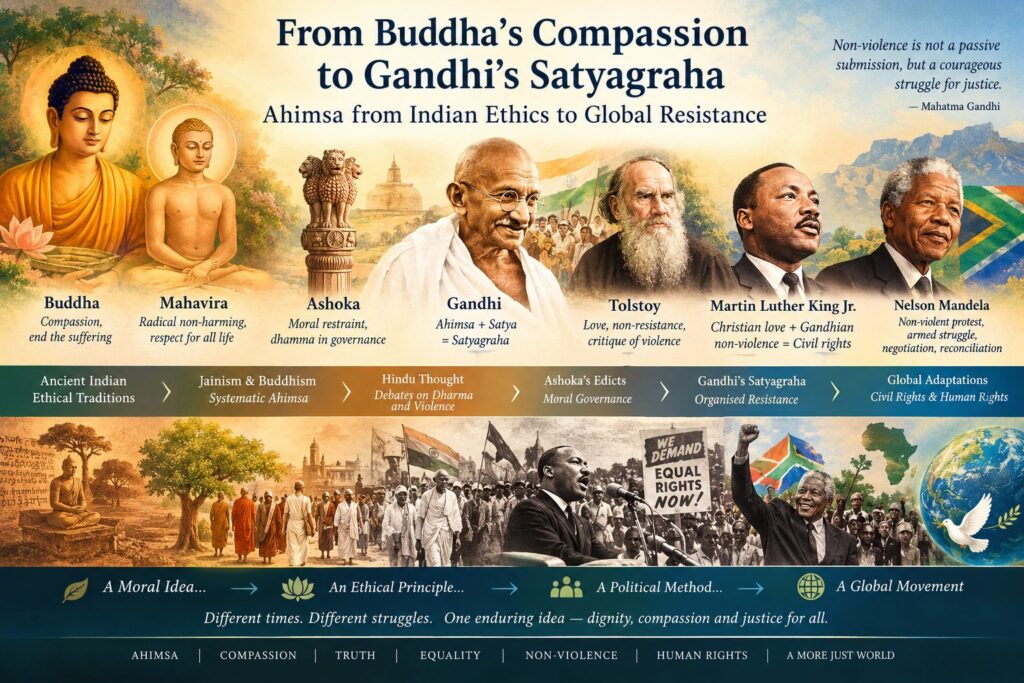
From Buddha’s Compassion to Gandhi’s Satyagraha: Ahimsa from Indian Ethics to Global Resistance

Introduction Few ethical ideas have travelled such a remarkable historical distance as ahiṃsā, usually translated as non-violence or non-harming. What began within the religious and philosophical traditions of ancient India as a question of how human beings ought to conduct themselves towards other living beings eventually acquired a much wider political meaning. In the twentieth

From Buddha’s Compassion to Gandhi’s Satyagraha: Ahimsa from Indian Ethics to Global Resistance Read More »

Women Empowerment Since Independence: From Equality to Representation, and the Nari Shakti Bill

he story of women empowerment in India since independence is one of gradual transformation, constitutional reform, social struggle, and democratic expansion. From receiving equal voting rights at the birth of the Republic to the contemporary debate over the Nari Shakti Vandan Adhiniyam 2023, India’s journey reflects a larger global pattern also visible in Europe and

Women Empowerment Since Independence: From Equality to Representation, and the Nari Shakti Bill Read More »

From Budapest to the World: What Hungarian Literature Reveals About Trauma, Identity, and the Making of Global Prize-Winning Writers

In recent years, Hungary—a relatively small Central European nation—has drawn global literary attention. The country produced a Nobel Prize–winning author in literature, Imre Kertész, and has also been closely associated with global literary recognition through writers such as László Krasznahorkai and David Szalay, whose novel Flesh won the Booker Prize in 2025. These achievements have

From Budapest to the World: What Hungarian Literature Reveals About Trauma, Identity, and the Making of Global Prize-Winning Writers Read More »

Some of the well-known post-independence debates and speeches

We Indians love arguments and debates and why not? Some of the well-known post-independence debates and speeches in parliament and the public are by Jawaharlal Nehru, Dr. B R Ambedkar, Atal Behari Vajpayee, Indira Gandhi, Ram Manohar Lohia, Sardar Vallabhbhai Patel Jawaharlal Nehru On 14 August 1947, Nehru, in an address to the Constituent Assembly,

Some of the well-known post-independence debates and speeches Read More »

An invitation to talented students to submit articles on current affairs for truevigyan.com

If you are a student of mass communication, journalism, economics, political or social science or arts or preparing for the administrative examination, you may like to submit articles related to social, economic, political, historical topics, the broad outlines of which are as below:- Climate change. Indian border disputes. National movements. Indian physiography. Post-independence politics. Role

An invitation to talented students to submit articles on current affairs for truevigyan.com Read More »

Answer to World History Quiz – (aWH0001)

Note: The quiz has five questions. Each has two option one true and other false. Question 1:-Italian painter “Leonardo da Vinci”, Italian astronomer “Galileo” Belong to a period in Europe which can be classifies as A-Dark age B-Age of Renaissance Answer:- B Question 2:- The first country in which industrial revolution started is A- United

Answer to World History Quiz – (aWH0001) Read More »

World History Quiz – (WH0001)

Note: The quiz has five questions. Each has two option one true and other false. Question 1:-Italian painter “Leonardo da Vinci”, Italian astronomer “Galileo” Belong to a period in Europe which can be classifies as  A-Dark age B-Age of Renaissance  Question 2:- The first country in which industrial revolution started is   A- United States Of

World History Quiz – (WH0001) Read More »

Scroll to Top