
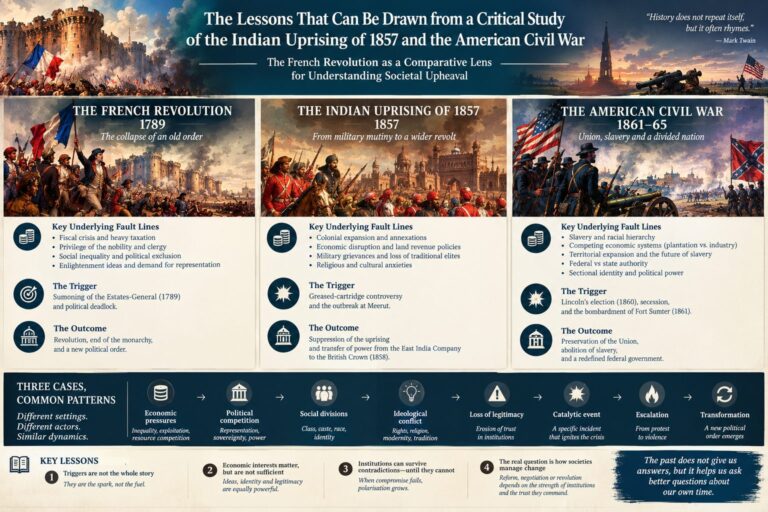
History contains moments when societies appear to change suddenly. A revolt begins in one place, a government loses authority, a political disagreement becomes violent, or a military confrontation develops into a much larger conflict. Yet major upheavals rarely emerge from a single incident. Behind the visible explosion usually lies a longer accumulation of economic pressures, political disputes, social divisions, cultural anxieties and competing ideas of legitimacy.
The Indian Uprising of 1857 and the American Civil War provide two particularly revealing examples. They were fundamentally different historical events: 1857 was an uprising against an expanding colonial power, whereas the American Civil War was a conflict within an established republic that developed into a struggle over Union, slavery and the future political order of the United States. The French Revolution provides an earlier and particularly useful comparative lens because it demonstrates another form of systemic crisis: the collapse and transformation of an established political and social order.
The purpose of comparing these three events is therefore not to suggest that they were equivalent. Rather, the comparison allows us to ask a broader historical question: what happens when accumulated contradictions become too great for existing institutions to absorb?
When Contradictions Begin to Reinforce One Another
Every society contains contradictions. Economic inequality may coexist with political stability; cultural differences may exist without producing violence; competing regional interests can often be reconciled through negotiation. A crisis develops when several contradictions begin reinforcing one another.
This can be represented as:
Economic pressure → political grievance → social polarisation → loss of institutional legitimacy → confrontation → systemic upheaval.
The precise components differed in France, India and the United States, but the underlying pattern is striking.
In late eighteenth-century France, the monarchy faced a severe fiscal crisis, an inefficient and unequal taxation system, resistance to reform and growing social and political dissatisfaction. The financial crisis became sufficiently acute that Louis XVI summoned the Estates-General in 1789. What began partly as a problem of state finance rapidly became a constitutional crisis and then a revolution.
In India, the East India Company’s territorial expansion, political interventions, economic policies, military grievances and cultural and religious anxieties generated resistance among different groups. The uprising began with a mutiny among sections of the Bengal Army but expanded into a much wider rebellion in parts of northern and central India. British archival material itself demonstrates that the causes cannot be reduced to one grievance or one group.
In the United States, sectional tensions had accumulated for decades around slavery, economic interests, territorial expansion, federal power and competing social systems. The National Park Service identifies economic practices, cultural values, federal authority and, most importantly, slavery as central elements of the crisis.
Thus, in all three cases, the visible crisis was preceded by a deeper crisis of accommodation.
The French Revolution: When a Fiscal Crisis Became a Crisis of Legitimacy
The French Revolution is an especially useful starting point because it illustrates how an apparently technical problem can become a fundamental political crisis.
By the late 1780s, the French monarchy faced severe financial difficulties. The fiscal system was unable to generate sufficient revenue, while privileged groups resisted reforms that threatened their exemptions and privileges. France’s involvement in expensive wars, including support for the American Revolution, added to the burden.
At the same time, poor harvests and rising food prices intensified social distress. The existing division into clergy, nobility and the Third Estate created a political structure in which social privilege and political representation were increasingly difficult to reconcile with changing economic and intellectual conditions.
The crucial development was that the monarchy could no longer solve its financial problem without confronting the privileges embedded in the political system itself.
The summoning of the Estates-General in May 1789 therefore became much more than a financial exercise. The Third Estate challenged the existing rules of political representation and eventually declared itself the National Assembly. The fiscal problem had become a question of who possessed legitimate political authority.
This provides the first model:
A financial crisis became a political crisis because solving the financial problem required changing the distribution of political privilege.
The French example therefore demonstrates that institutions can become unstable when they are expected to solve problems that their own structure prevents them from addressing.
India, 1857: When Colonial Expansion Met Cultural and Political Resistance
The Indian experience was fundamentally different because the central contradiction was not between two sections of one sovereign republic. It was between an expanding colonial authority and a population whose political, social and economic interests were increasingly affected by that expansion.
The East India Company’s expansion altered existing political arrangements and displaced or threatened established elites. Economic and administrative changes affected different sections of society in different ways. Within the Bengal Army, sepoys also developed grievances concerning service conditions, discipline and perceived threats to religious and cultural practices.
The controversy surrounding the new rifle cartridges became the immediate catalyst because of the belief that they were greased with cow and pig fat, creating profound religious concerns among Hindu and Muslim soldiers.
Yet the cartridge controversy alone cannot explain the scale of the uprising. British archival educational material on 1857 explicitly asks why so many Indians decided to fight and presents evidence concerning attitudes towards British government, military grievances and wider opposition to British rule.
The revolt that began among sepoys therefore acquired a much wider political character in several regions. The symbolic restoration of Mughal authority in Delhi and the involvement of princes, soldiers, landlords, peasants and other groups demonstrate that different actors could participate in the same upheaval while pursuing different objectives.
This produces a second model:
Colonial expansion and accumulated grievances created a reservoir of resistance; a military and cultural controversy provided the spark that allowed that resistance to erupt into a much larger political upheaval.
The eventual consequence was itself transformative. The East India Company’s governing role ended, and British India came under direct Crown rule in 1858. British archival material records the transition from Company administration to the new system following the rebellion.
America: When Sectional Conflict Became Civil War
The American case presents yet another configuration.
The United States developed two increasingly different socioeconomic systems. The South remained heavily dependent upon plantation agriculture and enslaved labour, while the North became increasingly industrial and associated with free labour and commercial capitalism. The two systems were not completely separate: Northern commerce and industry were deeply connected to Southern cotton and the slave economy. Nevertheless, their social and political visions increasingly diverged.
Slavery was therefore simultaneously an economic institution, a system of racial hierarchy, a source of political power and a constitutional problem.
The expansion of the United States into western territories repeatedly reopened the question of whether slavery would expand into new states and territories. The Missouri Compromise, the Compromise of 1850, the Kansas-Nebraska Act, the violence in Kansas and the Dred Scott decision were successive manifestations of an unresolved conflict.
The crisis became acute with Abraham Lincoln’s election in 1860. Southern leaders increasingly regarded Republican opposition to the expansion of slavery as a threat to the future security of the institution. Seven Southern states seceded before Lincoln’s inauguration, forming the Confederacy.
The bombardment of Fort Sumter on 12 April 1861 then converted the political crisis into open warfare.
Here again, the distinction between underlying cause and immediate trigger is essential.
Fort Sumter did not create the sectional conflict. It provided the military point at which an already-developed constitutional crisis became war.
The Three Triggers and the Three Structural Crises
The comparison becomes particularly revealing when the three cases are placed side by side:
| Historical case | Deeper contradictions | Catalytic development | Result |
|---|---|---|---|
| France, 1789 | Fiscal crisis, privilege, social inequality, political exclusion | Estates-General and constitutional confrontation | Revolution and destruction of much of the old political order |
| India, 1857 | Colonial expansion, political displacement, military grievances, economic and cultural anxieties | Cartridge controversy and outbreak at Meerut | Major uprising and subsequent transfer from Company to Crown rule |
| USA, 1861 | Slavery, sectional economic interests, territorial expansion, political polarisation and federalism | Secession followed by Fort Sumter | Civil War, preservation of the Union and abolition of slavery |
The comparison demonstrates an important principle:
A trigger explains when a crisis explodes; it does not necessarily explain why the society was combustible in the first place.
The storm may have been building for years before the lightning strike.
Economic Interests: Important, but Never Sufficient
This framework also allows a more sophisticated examination of the economic interpretation of history.
Economic interests unquestionably mattered in all three cases. France’s fiscal crisis was fundamental to the political breakdown of 1789. In India, colonial revenue and economic restructuring formed part of the background to resistance. In America, slavery was inseparable from the Southern economy, while Northern economic development increasingly rested on a different conception of labour.
But economic explanations become inadequate when they attempt to explain everything.
People do not fight only because of material interests. They also fight because of identity, religion, political legitimacy, perceived humiliation, fear, constitutional principle and ideas about the future.
The American Civil War illustrates this particularly well. It would be too simplistic to describe the conflict merely as Northern industrialists attempting to acquire Southern labour. Northern industry depended substantially upon Southern cotton, and many Northern commercial interests benefited from the slave economy. At the same time, the political conflict over slavery was genuine and increasingly irreconcilable. Contemporary Confederate declarations and speeches make the centrality of slavery to secession difficult to dismiss.
The economic explanation is therefore strongest when understood as one component of a wider political economy, rather than as a single master cause.
The Crisis of Legitimacy
Perhaps the most important common thread among the three cases is the loss of legitimacy.
A political system does not require universal satisfaction to survive. It requires sufficient acceptance of its rules.
The French monarchy lost legitimacy when its existing institutions appeared incapable of resolving the fiscal and representative crisis.
The East India Company’s authority faced a profound challenge when sections of Indian society perceived its expansion as threatening political authority, economic interests, religious practices and established social arrangements.
The American Union entered a legitimacy crisis when an increasingly sectional political system could no longer reconcile fundamentally different positions concerning slavery, territorial expansion and federal authority.
The crucial transition was therefore:
Grievance → distrust → polarisation → loss of legitimacy → confrontation.
Once enough actors cease believing that existing institutions can protect their essential interests, political compromise becomes progressively harder.
Why Some Crises Become Revolutions and Others Become Civil Wars
The three cases also demonstrate that structural crisis does not determine the precise form of violence.
France experienced a revolutionary transformation because the conflict centred on the legitimacy and structure of the existing regime itself.
India experienced an uprising against colonial authority, but the participants did not constitute a single unified political movement with one universally agreed objective.
America experienced civil war because the crisis developed between competing political communities claiming incompatible futures within—or outside—the same constitutional order.
Thus, similar categories of pressure can generate very different outcomes depending on the institutional structure of the society.
This is an important warning against historical determinism.
The existence of inequality does not automatically produce revolution.
Economic conflict does not automatically produce civil war.
Cultural anxiety does not automatically produce rebellion.
What matters is how these pressures interact with institutions, political leadership, collective identities and perceptions of legitimacy.
The Breakdown of Compromise
Another lesson common to the three cases is the importance of failed compromise.
France had attempted reform before 1789, but privileged interests and institutional obstacles prevented the monarchy from resolving its fiscal problems. The eventual summoning of the Estates-General opened a political process that escaped the control of the monarchy.
In America, successive compromises postponed rather than permanently resolved the conflict over slavery. The Missouri Compromise temporarily stabilised the sectional balance, but westward expansion repeatedly reopened the question. By the 1850s, political compromise was becoming increasingly difficult.
In India, there was no equivalent constitutional mechanism through which the colonised population could negotiate the fundamental question of sovereignty with the East India Company.
This difference is crucial. Institutions can only mediate conflict when the relevant groups believe that the institutions themselves are legitimate.
What These Three Cases Teach About Historical Change
The most important lesson is perhaps methodological.
Historical upheavals should be analysed at four different levels:
1. Structural conditions
These are the long-term economic, political and social arrangements that create tensions.
2. Accumulated grievances
These are the specific experiences through which people come to perceive those structures as unjust, threatening or intolerable.
3. Political breakdown
This occurs when established institutions lose their capacity to reconcile competing interests.
4. Catalytic events
These are the incidents that transform a simmering crisis into open confrontation.
This distinction prevents the historian from confusing the spark with the fuel.
The Bastille did not create every contradiction of eighteenth-century France. The cartridges did not create every grievance in India. Fort Sumter did not create the American sectional crisis.
Each became historically explosive because the surrounding political environment was already unstable.
A Broader Lesson for the Study of Societies
The comparison also suggests a broader proposition about political stability.
A society is not necessarily stable because it has no contradictions. Every complex society has contradictions.
It remains stable when it possesses institutions capable of negotiating those contradictions peacefully.
The danger begins when:
economic interests become politically irreconcilable;
social divisions become identities;
political compromise becomes regarded as betrayal;
institutions lose legitimacy;
each side begins to fear the future more than it values compromise;
and finally,
a triggering event converts political disagreement into collective action.
At that point, even a relatively small incident can acquire enormous historical significance.
Conclusion: From the Spark to the Structure
The French Revolution, the Indian Uprising of 1857 and the American Civil War cannot be placed in the same historical category. Their causes, actors, political objectives and consequences were profoundly different.
Yet they can be placed within the same analytical framework.
France demonstrates how a fiscal crisis can become a crisis of political legitimacy and ultimately revolution.
India demonstrates how colonial expansion and accumulated military, political, economic and cultural grievances can transform a military mutiny into a wider uprising.
America demonstrates how an unresolved conflict over slavery, political power, territorial expansion and competing socioeconomic systems can ultimately destroy the possibility of sectional compromise and produce civil war.
The deepest lesson is therefore not that revolutions or wars are caused by one particular grievance. It is that societies become vulnerable to major upheaval when several contradictions reinforce one another and the institutions capable of reconciling them cease to command sufficient legitimacy.
A useful historical formula may therefore be:
Contradiction creates pressure.
Grievance gives that pressure social form.
Political polarisation removes the space for compromise.
Institutional failure produces crisis.
A trigger releases the accumulated pressure.
The resulting conflict transforms the political order.
Seen in this way, the value of studying 1789, 1857 and 1861 together is not to force them into a single theory of revolution. It is to understand a more universal problem of political history:
How does a society move from disagreement to instability, from instability to confrontation, and from confrontation to transformation?
The answer differs from one historical setting to another. But the comparison demonstrates that the most consequential upheavals are rarely born on the day they become visible. They are usually decades in the making.