
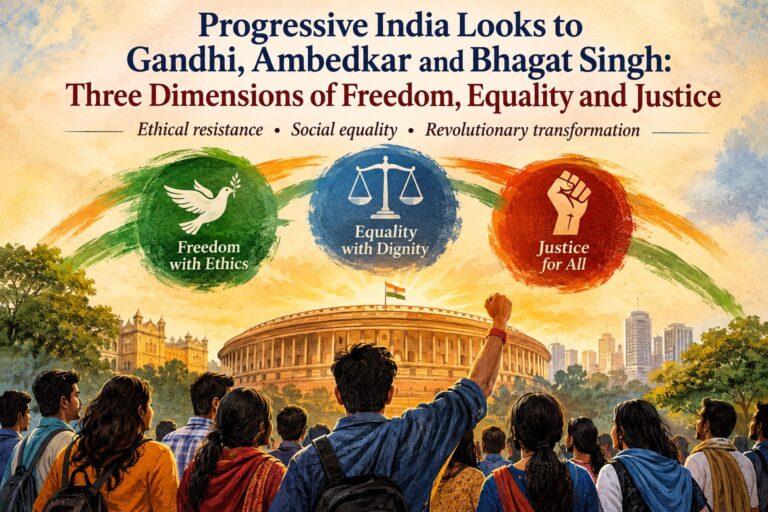
An exploration of three intellectual traditions that continue to shape India’s search for a just, democratic and progressive society.


The growing attraction of Mahatma Gandhi, Dr. B.R. Ambedkar and Bhagat Singh among sections of India’s progressive youth is an interesting phenomenon. At first glance, it might appear unusual that three individuals who held considerably different political and philosophical positions should find themselves occupying a common space in the imagination of young Indians. Gandhi stood for non-violent resistance and moral transformation; Ambedkar demanded the annihilation of caste and the establishment of social and constitutional equality; Bhagat Singh represented revolutionary nationalism, socialism and an uncompromising challenge to colonial authority and exploitation.
Yet, perhaps it is precisely because of their differences that these three figures have acquired such enduring relevance. They represent three distinct but complementary dimensions of the larger question of human emancipation: Gandhi’s insistence on the ethics of freedom, Ambedkar’s insistence on the equality of human beings, and Bhagat Singh’s insistence on the transformation of the structures that perpetuate exploitation. Their combined appeal suggests that progressive India is not necessarily searching for a single political doctrine but for a broader intellectual framework within which freedom, dignity and justice can coexist.
Gandhi: The ethics of freedom and the courage of non-violence

Gandhi’s contribution to political thought extends well beyond his leadership of India’s freedom movement. He transformed non-violence from an individual moral principle into a method of mass political resistance. Through satyagraha, he demonstrated that resistance to injustice need not necessarily reproduce the violence of the oppressor.
His disagreement with revolutionary nationalists, particularly Bhagat Singh and Subhas Chandra Bose, was rooted in a fundamental difference over the means through which political freedom should be achieved. Gandhi believed that the means employed in pursuing an objective were inseparable from the moral character of the objective itself. For him, a just society could not be built through methods that normalised violence and coercion.
This proposition remains relevant to contemporary political life. It raises an enduring question: can a society establish lasting justice if its methods of pursuing justice undermine the very values it seeks to protect?
Gandhi also offers an important perspective on religious pluralism, individual responsibility, environmental restraint and decentralised democracy. His critique of excessive materialism and industrial civilisation, although not without limitations, has acquired renewed relevance in an age of ecological degradation and unsustainable consumption.
However, engaging seriously with Gandhi also requires acknowledging his contradictions, particularly his evolving but contested positions on caste and varna. His approach to untouchability and social reform differed fundamentally from Ambedkar’s demand for the annihilation of caste.
Gandhi’s enduring contribution, therefore, should not be understood as the provision of ready-made answers to every contemporary problem. Rather, it lies in the questions he compels us to ask about the relationship between political power, moral responsibility and the means through which social transformation is pursued.
Ambedkar: The struggle for dignity, equality and constitutional morality

If Gandhi emphasised the moral transformation of society, Ambedkar brought the structural foundations of social inequality to the centre of India’s political discourse.
For Ambedkar, political independence could not constitute genuine freedom while millions continued to experience discrimination, exclusion and humiliation because of their caste identity. His understanding of caste went far beyond its economic implications. He recognised it as a system of graded inequality that regulated social relationships, access to knowledge, occupational opportunities and political power.
His disagreement with Gandhi was therefore not simply a disagreement over methods. It concerned the very nature of the social order that an independent India should seek to establish.
Where Gandhi placed considerable faith in moral reform and the transformation of Hindu society, Ambedkar insisted that the oppressed could not be expected to depend upon the goodwill of those who benefited from the existing hierarchy. They needed independent political agency, constitutional safeguards, equal citizenship and the power to determine their own future.
The significance of Ambedkar’s contribution lies in his insistence that democracy cannot be reduced to electoral competition or the formal equality of citizens before the law. It must also be reflected in the everyday social and economic relationships between human beings.
His conception of liberty, equality and fraternity provides a particularly important framework for understanding this challenge.
Ambedkar also reminds progressive India that social harmony cannot be achieved by asking historically disadvantaged communities to accommodate themselves to an unjust social order. Reconciliation without justice risks becoming another expression of inequality.
His legacy is therefore indispensable to any meaningful discussion of social reform, constitutional democracy and the future of Indian society.
Bhagat Singh: Revolutionary courage and the transformation of society

Bhagat Singh represents another dimension of the struggle for freedom. His significance extends far beyond his martyrdom and his participation in revolutionary activities against British colonial rule.
What makes Bhagat Singh particularly relevant is the intellectual evolution reflected in his writings. He was not merely a revolutionary seeking the removal of British rulers. He increasingly questioned the economic and social structures that enabled exploitation, inequality and the concentration of power.
His commitment to socialism reflected the belief that political independence would remain incomplete if the economic foundations of exploitation were left undisturbed.
His essay Why I Am an Atheist also reveals an important aspect of his intellectual personality: an insistence on independent reasoning and the willingness to question inherited beliefs and established authority.
Bhagat Singh’s political imagination was therefore considerably larger than the conventional image of a young revolutionary sacrificing his life for the nation. He envisioned a society in which freedom would mean more than a change in political rulers.
His revolutionary outlook differed fundamentally from Gandhi’s commitment to non-violence. Their disagreement over the use of revolutionary violence should not be obscured in an attempt to manufacture an artificial intellectual consensus.
Nevertheless, both were responding to the fundamental injustice of colonial domination, although through different political philosophies.
For progressive youth, Bhagat Singh represents intellectual courage, resistance to oppression and the conviction that political independence must ultimately translate into a more egalitarian social and economic order.
Three traditions, one larger question
The intellectual significance of bringing Gandhi, Ambedkar and Bhagat Singh together lies not in pretending that their philosophies were identical, but in understanding the different dimensions of freedom that each sought to address.
Their respective contributions can be understood through three fundamental questions.
| Thinker | Central concern | The question for society |
|---|---|---|
| Gandhi | Ethical freedom | Are our means consistent with the ends we seek? |
| Ambedkar | Social emancipation | Can freedom exist without equality and dignity? |
| Bhagat Singh | Revolutionary transformation | Can political independence exist without economic and social liberation? |
These questions are not mutually exclusive. In fact, they expose the limitations of pursuing any one dimension of freedom while neglecting the others.
Political resistance without an ethical framework can degenerate into another form of domination. Constitutional equality without meaningful social transformation can remain largely formal. Political independence without economic emancipation can leave existing structures of exploitation intact.
Taken together, these three traditions invite us to consider freedom as a multidimensional undertaking.
The missing bridge: Ram Manohar Lohia and the integration of social transformation

An interesting additional dimension emerges when we bring Ram Manohar Lohia into this discussion.
Lohia’s political philosophy attempted to connect Gandhian methods of political mobilisation with socialist economic transformation and Ambedkarite concerns about caste and social representation.
One of his most significant contributions was his insistence that caste could not be treated merely as an economic category. His famous observation, “Caste is immobile class, while class is mobile caste,” captured his understanding that economic mobility alone could not dismantle inherited social hierarchies.
Lohia recognised that a socialist transformation of India would remain incomplete unless caste-based inequalities were simultaneously confronted. His advocacy of preferential opportunities for backward communities was an attempt to translate social justice into a redistribution of political and institutional power.
His concept of Sapt Kranti, or Seven Revolutions, further expanded this vision by addressing caste, class, gender, race, imperialism, individual freedom and militarism as interconnected challenges.
His idea of Chaukhamaba Raj, or the Four-Pillar State, also attempted to combine decentralised democracy with a socialist understanding of the distribution of political power.
Lohia did not completely reconcile Gandhi and Ambedkar, nor did his approach eliminate the differences between them. Nevertheless, his political thought provides an interesting framework for understanding how ethical transformation, social emancipation and economic restructuring might become parts of a common democratic project.
Self-purification versus self-respect: The deeper lesson of the Gandhi–Ambedkar debate

The discussion becomes even more meaningful when viewed through D.R. Nagaraj’s essay, Self-Purification versus Self-Respect: On the Roots of the Dalit Movement.
Nagaraj examines the contrasting approaches of Gandhi and Ambedkar towards the emancipation of Dalits.
Gandhi’s emphasis on self-purification placed considerable responsibility on caste Hindu society to recognise its historical wrongdoing, confront its prejudices and undertake moral reform.
Ambedkar’s emphasis on self-respect, on the other hand, placed the oppressed community at the centre of its own emancipation. Liberation could not depend on the moral awakening or goodwill of privileged communities.
This distinction raises a fundamental question: who has the authority to bring about social transformation?
A society cannot expect its historically oppressed communities to wait indefinitely for the moral transformation of those who perpetuate discrimination. Equally, the long-term elimination of caste requires a transformation of the social relationships and institutions through which inequality is reproduced.
Nagaraj’s interpretation is valuable because it encourages us to move beyond a simplistic Gandhi-versus-Ambedkar framework. It allows us to recognise that the moral transformation of society and the assertion of dignity by the oppressed are related processes, even though neither can be made conditional upon the other.
This has particular relevance for contemporary India. Social harmony cannot be achieved merely through appeals to unity, just as social justice cannot be sustained without establishing relationships based on mutual recognition and equal citizenship.
What does this combination mean for progressive India?
The attraction of these three figures among sections of India’s progressive youth can be interpreted as a search for a political imagination that goes beyond conventional ideological divisions.
Young Indians confronting questions of unemployment, economic inequality, caste discrimination, political freedom, religious identity and environmental degradation may find different intellectual resources in these three figures.
Gandhi offers a vocabulary of ethical resistance and personal responsibility. Ambedkar provides a framework for understanding structural inequality and constitutional democracy. Bhagat Singh brings questions of economic exploitation, revolutionary change and intellectual independence into the discussion.
Their combined appeal also offers an opportunity to rethink nationalism.
Nationalism need not be reduced to unquestioning loyalty to political authority, nor should criticism of existing institutions automatically be interpreted as hostility towards the nation. A commitment to building a more just society can itself be an expression of national responsibility.
At the same time, these figures should not be reduced to convenient political symbols. Gandhi must be studied with his contradictions, Ambedkar with the radical implications of his critique of caste, and Bhagat Singh with the depth of his socialist and secular thought.
Their intellectual legacies deserve engagement, not merely celebration.
There is also an important distinction between the symbolic popularity of these figures and demonstrable intellectual engagement with their writings. While surveys and student movements offer indications of their continuing appeal, it would be premature to claim that all progressive Indian youth subscribe to a common Gandhi–Ambedkar–Bhagat Singh philosophy.
The proposition is better understood as an emerging intellectual possibility than as an established national consensus.
Conclusion: Freedom, equality and justice must travel together
Perhaps the most productive way of understanding these three figures is to recognise that each exposes a different incompleteness in the pursuit of freedom.
Gandhi reminds us that the struggle for justice must remain conscious of its ethical foundations.
Ambedkar reminds us that freedom without equality and dignity is an inadequate conception of democracy.
Bhagat Singh reminds us that political independence without the transformation of economic and social structures cannot constitute complete emancipation.
Lohia, meanwhile, reminds us that these concerns must be translated into an integrated programme of social, economic and political transformation.
The challenge before progressive India is not to choose one of these intellectual traditions at the expense of the others. It is to engage with their disagreements, preserve their distinct contributions and examine how their ideas can inform the problems of the present.
A democratic society needs the moral courage to resist injustice, the constitutional commitment to protect equality and the intellectual courage to question structures of exploitation.
Perhaps that is the larger significance of Gandhi, Ambedkar and Bhagat Singh as three dimensions of progressive India: freedom must be ethically pursued, equality must be institutionally secured, and justice must be socially and economically realised.