
Introduction
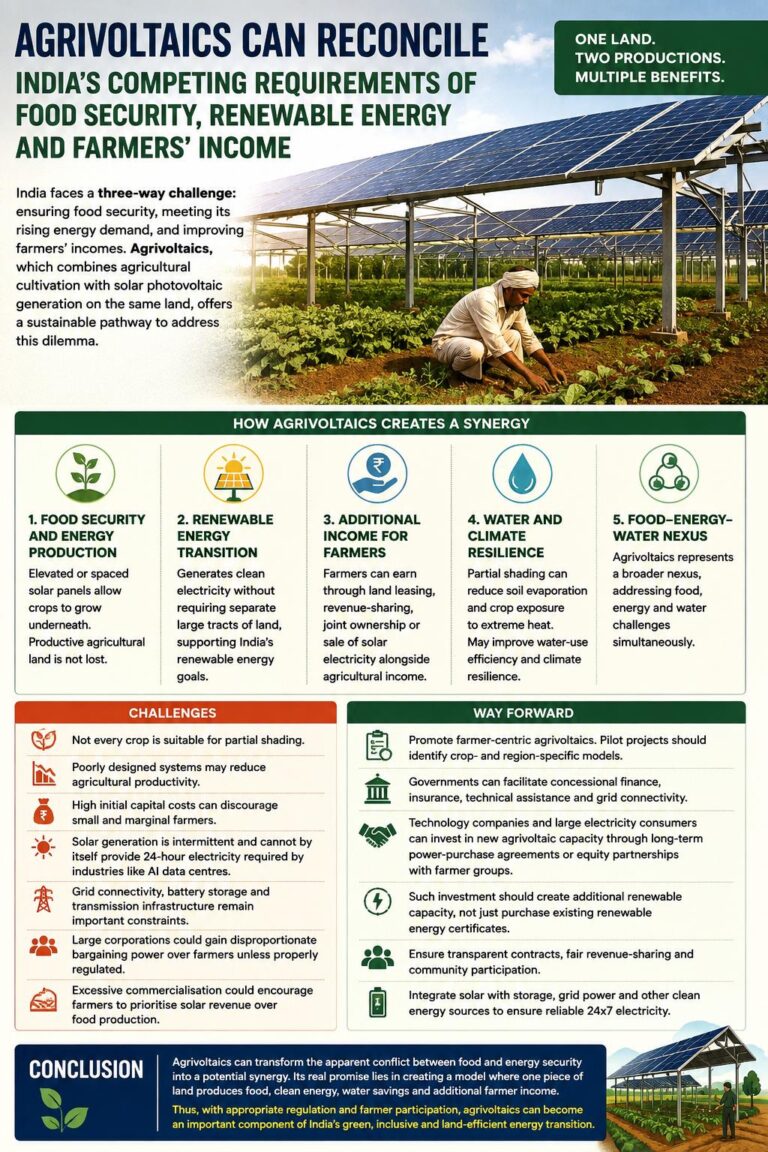
India faces a three-way challenge: ensuring food security, meeting its rapidly rising energy demand, and improving farmers’ incomes. Conventional solar parks can create competition for land, while dependence on fossil fuels increases environmental costs. Agrivoltaics, which combines agricultural cultivation with solar photovoltaic generation on the same land, offers a potential solution to this dilemma.
How agrivoltaics can create a synergy
1. Food security and energy production
Agrivoltaics follows the principle of dual land use. Elevated or appropriately spaced solar panels allow cultivation to continue underneath or between the panels. Thus, productive agricultural land does not necessarily have to be completely converted into solar parks.
2. Renewable energy transition
Solar panels can generate clean electricity without requiring a separate large tract of land exclusively for energy generation. This can contribute to India’s renewable-energy ambitions and reduce dependence on coal-based electricity.
3. Additional income for farmers
Farmers can potentially earn through land leasing, revenue-sharing, joint ownership or sale of solar electricity, alongside their agricultural income. This can diversify rural incomes and reduce farmers’ dependence on a single source of livelihood.
4. Water and climate resilience
In suitable regions, partial shading can reduce soil evaporation and crop exposure to extreme heat. Agrivoltaics may therefore improve water-use efficiency and climate resilience, although the benefits vary considerably by crop, climate and system design.
5. Food–Energy–Water nexus
Agrivoltaics represents a broader food–energy–water nexus, in which the same land and infrastructure can simultaneously address multiple development challenges.
Challenges
Despite its promise, agrivoltaics is not a universal solution.
- Not every crop is suitable for partial shading.
- Poorly designed systems may reduce agricultural productivity.
- High initial capital costs can discourage small and marginal farmers.
- Solar generation is intermittent and therefore cannot by itself provide the 24-hour electricity required by industries such as AI data centres.
- Grid connectivity, battery storage and transmission infrastructure remain important constraints.
- Large corporations could gain disproportionate bargaining power over farmers unless contracts and land-use arrangements are properly regulated.
- Excessive commercialisation could ultimately encourage farmers to prioritise solar revenue over food production.
Way forward
India should promote farmer-centric agrivoltaics rather than simply converting agricultural land into solar parks. Pilot projects should identify crop- and region-specific models, while governments can facilitate concessional finance, insurance, technical assistance and grid connectivity.
Technology companies and large electricity consumers could also invest in new agrivoltaic capacity through long-term power-purchase agreements or equity partnerships with farmer groups. Such investment would be more meaningful if it creates additional renewable capacity rather than merely purchasing existing renewable-energy certificates.
Conclusion
Agrivoltaics can transform the apparent conflict between food and energy security into a potential synergy. Its real promise lies not merely in putting solar panels over farmland, but in creating a model where one piece of land produces food, clean energy, water savings and additional farmer income.
Thus, with appropriate regulation and farmer participation, agrivoltaics can become an important component of India’s green, inclusive and land-efficient energy transition.