
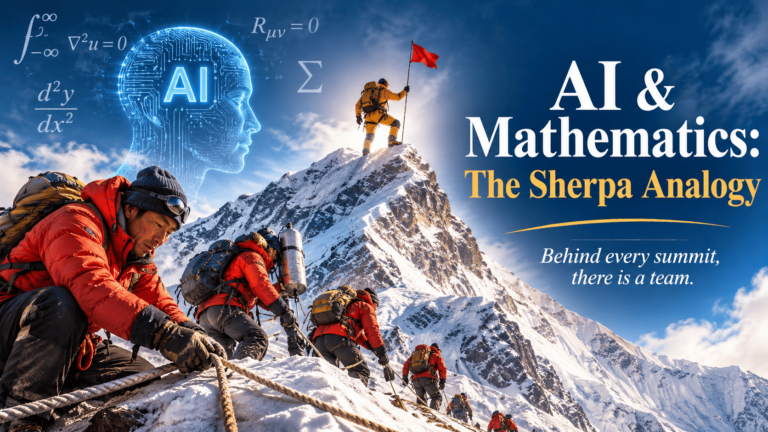
When a climber stands on the summit of Everest, the photograph shows one person, one flag and one achievement. It does not show the ropes fixed through the Khumbu Icefall, the oxygen carried to the high camps, or the people who made several trips up the mountain so that someone else could make one. Mathematics now faces the same photograph: an AI system settles a problem that resisted humans for decades, and the headline names the machine.
This article argues that AI’s role in tackling complex mathematical problems is what Sherpas are to scaling a mountain peak: indispensable, skilled and increasingly decisive, yet neither the reason the mountain is worth climbing nor a substitute for the mountaineer’s purpose. It reaches that view by working through six questions in turn: how significant Sherpas really are; whether mathematics is moving from a romantic to an industrial era; whether AI is truly artificial; whether an AI proof is a helicopter ride to the summit; whether Deep Blue’s victory over Kasparov offers comfort; and whether humans will always remain the masters of intelligent machines.
1. How significant are Sherpas when climbers scale Everest?
The contribution of Sherpas is fundamental, not merely supportive. In many commercial Everest expeditions they make the ascent practically possible, manage much of its logistical and technical complexity, and often accept more risk than the foreign climbers they accompany. Sherpas are not simply guides: many are highly skilled high-altitude mountaineers in their own right.
What Sherpas actually do
Their work spans almost the entire expedition:
- Route preparation: identifying and establishing safe routes through difficult terrain.
- Fixing ropes and ladders: installing fixed ropes and aluminium ladders, especially across dangerous sections such as the Khumbu Icefall.
- Transporting supplies: carrying tents, oxygen cylinders, food, fuel and equipment to higher camps.
- Establishing camps: building and stocking camps at successive elevations.
- Weather and route assessment: drawing on experience to help expedition leaders judge climbing windows.
- Guiding and assisting climbers: managing oxygen supplies, monitoring physical condition and helping in emergencies.
- Rescue operations: frequently undertaking dangerous rescues at extraordinary personal risk.
When a climber reaches the summit, the achievement is often the culmination of a much larger collective operation.
The Khumbu Icefall: an illustration
The Khumbu Icefall lies between Everest Base Camp and Camp I and is one of the most dangerous sections of the South Col route. It is a constantly shifting glacier of crevasses, unstable ice towers and collapsing seracs. Specialist high-altitude workers, many of them Sherpas, prepare the route with ladders and ropes. The work is hazardous because the glacier keeps moving: a route that is relatively safe one day can become dangerous the next.
The point is significant. Many climbers who eventually reach the summit do not independently establish the route they follow. They benefit from the labour, expertise and risk-taking of people who prepared it beforehand.
Who carries the greater danger?
Sherpas often make several journeys up and down the mountain, while a paying climber may make fewer rotations. A 2019 report drawing on Himalayan Database figures noted that Sherpas averaged about 3.5 ascents on Everest, against 1.5 for foreign climbers. Historical mortality research published in the British Medical Journal likewise found that Sherpas were disproportionately exposed to objective hazards such as avalanches, falling ice and crevasse accidents, which their repeated passages through the lower sections help explain. The 2014 Khumbu Icefall disaster, in which 16 Sherpas lost their lives, brought this inequality into sharp focus.
Does this diminish the climber’s achievement?
Suppose two mountaineers reach the summit. Mountaineer A independently carries equipment, establishes the route, manages the technical challenges and reaches the top. Mountaineer B employs an experienced team of Sherpas who fix ropes, establish camps, transport equipment and provide logistical and climbing assistance. Both have reached the summit, but they have not accomplished the same thing.
Mountaineer B has still shown real endurance, courage, acclimatisation and ability. It would be unfair to dismiss that accomplishment, and equally unfair to credit the whole expedition’s success to the person whose name appears in the record books. There is a difference between reaching the summit and independently accomplishing everything required to reach it.
Sherpas are not simply labourers
The Sherpa community has produced some of the world’s finest high-altitude mountaineers. Kami Rita Sherpa, with his extraordinary record of Everest ascents, shows that Sherpas do more than facilitate other people’s achievements: they are accomplished mountaineers themselves. A further distinction is worth keeping. The Sherpa ethnic community is not the same as the occupational category of high-altitude workers, and not every Nepali high-altitude worker is ethnically Sherpa, even though the term is often used loosely.
The larger insight: individual achievement and collective infrastructure
We celebrate the individual who reaches the summit, wins the contest, makes the discovery or builds the enterprise, yet behind each stands a network of less visible contributors.
| Achievement | Often less visible contribution |
| Climbing Everest | Sherpas, route-fixers and expedition teams |
| Scientific discovery | Research assistants, technicians and previous generations of scientists |
| Mathematical breakthroughs | Existing theories, accumulated proofs and collaborative work |
| Successful business | Employees, suppliers and institutional infrastructure |
| AI achievements | Human-generated knowledge, researchers, engineers and computing infrastructure |
This does not make individual achievement an illusion. It means that individual achievement is frequently enabled by collective effort. And it raises a question for AI: if a system produces an extraordinary mathematical result, should we attribute it entirely to the AI, ignoring the generations of mathematicians, programmers and engineers whose work made it possible? The Sherpa example warns against confusing the most visible participant with the whole source of an achievement. Reaching Everest is an individual accomplishment within a collective enterprise, and the summit photograph tells only a small part of the story.