
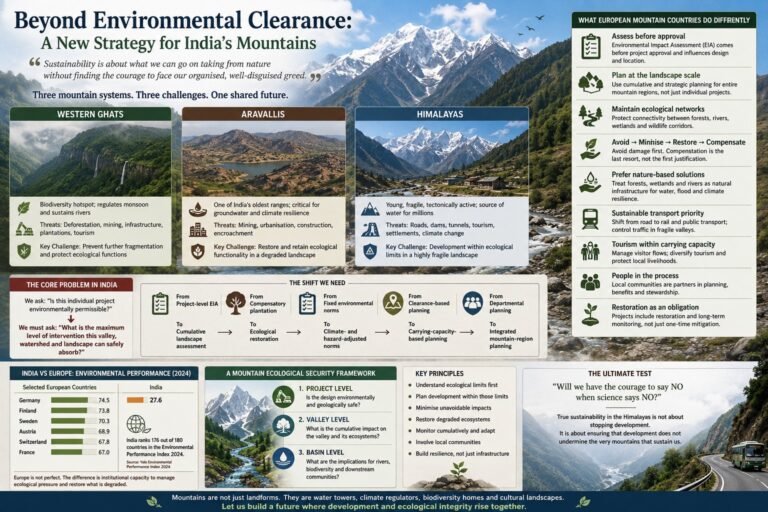
Sustainability is about what we can go on taking from nature without finding the courage to face our organised, well-disguised greed.
This observation acquires a particular force when we look at India’s three great mountain systems—the Western Ghats, the Aravallis and the Himalayas. All three are under pressure from roads, mining, tourism, urbanisation, infrastructure and changing patterns of resource use. Yet treating their sustainability problems as essentially identical would be a mistake. Their geology, ecological functions, vulnerability and relationship with human settlements are fundamentally different.
More importantly, the crisis in the Himalayas raises a larger question: has India’s conventional strategy for maintaining ecological integrity become inadequate for the scale and complexity of contemporary development?
The answer is not that India’s environmental institutions have failed completely. India possesses environmental laws, protected areas, impact-assessment procedures, scientific institutions, biodiversity programmes and an increasingly active judiciary. The problem lies deeper. A system designed primarily around assessing individual projects is increasingly inadequate for landscapes where the impact of hundreds of individually sanctioned interventions can become greater than the sum of their parts.
Three mountain systems, three different sustainability problems
The Western Ghats are among the world’s important biodiversity hotspots and perform enormous hydrological and climatic functions. Their principal sustainability challenge is the progressive fragmentation and degradation of a relatively old and ecologically rich mountain ecosystem through mining, quarrying, plantations, roads, dams, tourism and urban expansion.
The Aravallis present an even more dramatic story of ecological erosion. One of India’s oldest mountain systems has been progressively weakened by mining, construction, encroachment and urbanisation. Its significance extends far beyond biodiversity. The range influences groundwater recharge, moderates regional climate and acts as an ecological barrier against the eastward expansion of the Thar desert. In the Aravallis, sustainability is increasingly about how much ecological functionality can be retained in a landscape that has already suffered substantial degradation.
The Himalayas present a different and more difficult challenge.
They are young, tectonically active and geologically fragile. Their steep slopes, seismicity, intense rainfall, glaciers, snowfields and river systems create an unusually sensitive ecological and physical environment. Climate change is adding another layer of uncertainty through changing precipitation, glacier retreat, permafrost degradation and increasing risks from floods, landslides and glacial lake outburst floods.
Consequently, a road, tunnel, dam or hotel in the Himalayas cannot always be assessed simply as a discrete environmental intervention. Cutting a slope may alter drainage; altered drainage may destabilise a slope; slope instability may affect a road; the road may encourage settlement and tourism; and the cumulative alteration of a valley may change its hydrological and ecological behaviour.
The Himalayan problem is therefore not simply over-exploitation of nature. It is development occurring in a landscape whose physical tolerance for disturbance is exceptionally low.
The Himalayan paradox
There is an uncomfortable paradox at the heart of Himalayan development.
Mountain communities require roads, electricity, healthcare, education, communications, markets and employment. Telling Himalayan populations that their mountains must remain untouched is neither socially just nor economically realistic.
But poorly planned development can destroy precisely those ecological systems upon which mountain communities depend.
The answer, therefore, cannot be either unrestricted development or absolute conservation.
It has to be development within ecological limits.
This requires a fundamental change in the question we ask.
The conventional question is:
Is this particular project environmentally permissible?
The more appropriate Himalayan question should be:
How much additional intervention can this valley, watershed or landscape safely absorb—and at what point does development begin to undermine the ecological system itself?
That is a fundamentally different philosophy.
India’s project-by-project problem
India’s environmental governance has traditionally relied heavily upon project-level assessment. Such assessment remains essential, but its limitations become evident when multiple projects occupy the same landscape.
A hydropower project may individually satisfy prescribed conditions. A road may individually receive environmental clearance. A hotel may individually meet construction requirements. A transmission line may be justified independently.
But what happens when all of them occupy the same river valley?
The cumulative consequences may include deforestation, slope cutting, altered drainage, sedimentation, changes in river morphology, habitat fragmentation, increased traffic and settlement pressure.
This is why cumulative impact assessment must become much more important in Himalayan planning.
The unit of environmental governance should not always be the project.
In many Himalayan situations, it should be the valley, watershed and river basin.
What Europe does differently
The European Alpine experience offers a useful comparison—not because Europe has solved the mountain sustainability problem, nor because European mountains are pristine, but because several European countries have developed stronger mechanisms for managing development at the landscape scale.
The Alpine Convention brings together eight Alpine countries and addresses spatial planning, transport, energy, tourism, soil conservation, forests and nature protection through an integrated framework.
This is significant because mountain ecosystems do not recognise administrative departments.
A road is a transport project, but it is also a slope-management issue. A hydropower project is an energy project, but it is also a river-management issue. Tourism is an economic activity, but it is simultaneously a waste-management, water, transport and carrying-capacity issue.
European mountain governance increasingly recognises these interconnections.
Environmental impact assessment, strategic spatial planning, protected ecological networks, public participation, restoration programmes and greater emphasis on public transport provide a more integrated framework.
The European lesson is therefore not simply “build less.”
It is:
Understand the landscape first, establish its ecological limits, plan development accordingly, minimise unavoidable damage, restore degraded areas and continuously monitor the consequences.
That distinction matters enormously for India.
The question of ecological carrying capacity
One of the most important ideas India could institutionalise more systematically is carrying capacity.
Tourism provides an obvious example.
The relevant question for a Himalayan pilgrimage centre should not merely be:
How many tourists can hotels accommodate?
It should be:
How many people can the local water system supply, the sewage system treat, the roads safely transport, the slopes safely support and the ecosystem absorb?
The carrying capacity of a mountain destination is therefore not determined by the number of hotel rooms.
It is determined by the weakest ecological and infrastructural link.
This principle should extend to construction, traffic, water extraction, waste generation and even the number and location of infrastructure projects within a valley.
From mitigation to restoration
Another important change is the need to move beyond the narrow idea of environmental compensation.
Planting trees somewhere else cannot automatically compensate for the destruction of a mature forest ecosystem. Constructing a retaining wall cannot restore the ecological function of a destabilised slope. Financial compensation cannot recreate a river’s natural morphology.
A more credible hierarchy would be:
Avoid → Minimise → Restore → Compensate
The first objective should be avoiding ecological damage wherever possible.
Where damage cannot be avoided, it should be minimised.
Where degradation occurs, restoration should become an integral part of the project’s life cycle.
Compensation should be the last resort—not the first justification for environmental damage.
Mountains need natural infrastructure too
India’s development debate frequently treats roads, dams, tunnels and power stations as infrastructure while forests, wetlands, rivers and mountain slopes are treated as environmental constraints.
This distinction is increasingly untenable.
A forest that stabilises a slope is infrastructure.
A wetland that absorbs floodwater is infrastructure.
A functioning watershed that regulates water flows is infrastructure.
A healthy river system is infrastructure.
A stable mountain slope is infrastructure.
The difference is that much of this infrastructure is natural rather than constructed.
Destroying it and replacing it with increasingly expensive engineering structures may ultimately be economically irrational.
The future Himalayan strategy should therefore combine engineering with nature-based solutions rather than treating nature as an obstacle to engineering.
The real European comparison
If India’s mountain governance is compared with European countries, the issue should not be reduced to environmental rankings.
European countries have also extensively modified their mountain landscapes. The Alps contain roads, tunnels, dams, ski resorts, towns, industries and intensive tourism. Their environmental record is therefore far from perfect.
The more important difference is institutional.
European mountain regions have progressively developed mechanisms for spatial planning, ecological connectivity, cumulative assessment, restoration, public participation and cross-border coordination.
India possesses many of the individual ingredients but has yet to integrate them sufficiently into a coherent mountain-development philosophy.
This is perhaps India’s central weakness:
strong environmental institutions, but insufficiently integrated ecological planning.
Is India’s sustainability strategy outdated?
Calling India’s entire environmental system “outdated” would be an overstatement.
Calling the dominant project-by-project model increasingly inadequate is much more defensible.
Climate change has altered the risk landscape. Himalayan infrastructure is expanding rapidly. Tourism is increasing. Urban settlements are spreading. Extreme weather is becoming a more important planning consideration. Scientific understanding of cumulative ecological impacts is also improving.
A regulatory system designed mainly to determine whether one project crosses an environmental threshold may struggle when the threshold itself is being approached by hundreds of projects collectively.
India therefore needs an urgent transition:
from environmental clearance to ecological planning;
from individual projects to cumulative impacts;
from compensation to restoration;
from fixed standards to climate- and hazard-sensitive standards;
from departmental planning to integrated mountain-region planning;
from post-disaster response to anticipatory risk management.
Towards a Mountain Ecological Security Framework
What might a new approach look like?
Every major Himalayan infrastructure project could be assessed at three interconnected levels:
1. Project level:
Is the engineering design environmentally and geologically safe?
2. Valley level:
What is the cumulative effect of all existing and proposed roads, dams, tunnels, settlements and tourism infrastructure?
3. Basin level:
What are the implications for river flows, sediment, biodiversity, groundwater, downstream communities and long-term climate resilience?
Such a framework could also establish no-go zones, ecological thresholds, construction-free hazard zones, minimum river-flow requirements, limits on slope cutting, tourism carrying capacities and mandatory restoration obligations.
Most importantly, these limits should be determined before economic interests become politically invested in a project.
Sustainability requires political courage
Ultimately, this is not merely a technical debate.
India already has engineers, geologists, ecologists, hydrologists, economists and environmental scientists capable of designing better mountain policies.
The harder question is political:
Will governments be willing to say no when the science says no?
Will a road be realigned even if it costs more?
Will a hydropower project be rejected because a river basin has reached its ecological limit?
Will tourism numbers be restricted when local businesses demand more visitors?
Will construction be prohibited in a hazard-prone zone despite strong real-estate pressure?
Will restoration costs be treated as part of the economic cost of infrastructure rather than as an optional environmental expenditure?
These are the real tests of sustainability.
The Himalayan opportunity
The Himalayas should not become a museum. They must remain living landscapes in which people can build livelihoods, access markets and enjoy modern services.
But the objective cannot be to reproduce the development trajectory of the plains on mountain terrain.
Mountains require a different development paradigm.
The Western Ghats teach us the cost of fragmenting biodiversity-rich landscapes. The Aravallis demonstrate what happens when ecological systems are progressively sacrificed to extraction and urban expansion. The Himalayas offer perhaps the final warning: when ecological fragility, climate change and infrastructure expansion interact, environmental degradation can rapidly become a question of human safety and economic security.
The central challenge is therefore not choosing between development and conservation.
It is learning to distinguish development that strengthens human resilience from development that merely increases human exposure to ecological risk.
That is why India’s Himalayan strategy deserves an urgent revisit.
Not because everything that exists is obsolete.
But because the mountains are changing faster than the assumptions under which we continue to develop them.
And perhaps the most important principle for the next generation of Himalayan policy is this:
Do not ask only what nature can provide for development. Ask what ecological integrity must remain intact for development itself to remain sustainable.