
Introduction
In the previous article, we explored how environmental catalysis has become one of the most powerful tools for controlling pollution. Catalysts accelerate chemical reactions, reduce energy requirements, and enable the transformation of harmful pollutants into less harmful substances. However, chemistry is not the only source of catalytic power.
Long before humans discovered catalysts, nature had already perfected them.
Every living organism relies on biological catalysts known as enzymes. These remarkable molecules perform chemical reactions with extraordinary speed, precision, and efficiency. From digestion and respiration to photosynthesis and nutrient cycling, enzymes make life possible.
In recent decades, scientists have increasingly recognized that these biological catalysts can also be used to address environmental problems. The growing fields of bioremediation, environmental biotechnology, and enzyme engineering seek to harness nature’s catalytic machinery for pollution control.
This article explores the role of bioenzymes in environmental remediation, examines attempts to apply catalytic technologies to urban pollution problems, evaluates India’s experience in pollution management, and considers the future of environmental remediation.
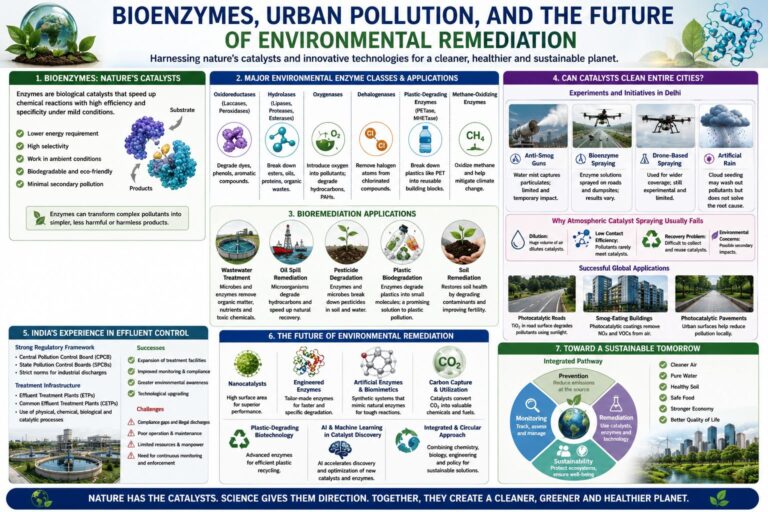
Bioenzymes: Nature’s Catalysts
Enzymes are biological molecules, usually proteins, that accelerate chemical reactions within living systems.
Like conventional catalysts, enzymes:
- Increase reaction rates
- Lower activation energy
- Remain unchanged after the reaction
However, enzymes possess several additional advantages:
- Exceptional selectivity
- High efficiency
- Operation under mild conditions
- Biodegradability
- Minimal secondary pollution
Because enzymes evolved through billions of years of biological evolution, they often perform reactions that remain difficult for synthetic catalysts to replicate.
Why Enzymes Matter in Environmental Protection
Many environmental pollutants are organic compounds that resemble substances naturally processed by microorganisms.
Consequently, biological systems often possess enzymatic pathways capable of degrading:
- Petroleum hydrocarbons
- Pesticides
- Dyes
- Pharmaceuticals
- Plastics
Instead of merely transferring pollutants from one location to another, enzymes can transform them into simpler and less harmful compounds.
This ability makes enzymes highly attractive for sustainable environmental remediation.
Major Environmental Enzyme Classes
Several enzyme families play important roles in pollution control.
Oxidoreductases
Oxidoreductases catalyze oxidation-reduction reactions.
Important examples include:
- Laccases
- Peroxidases
- Manganese peroxidases
Applications:
- Textile dye degradation
- Phenol removal
- Pharmaceutical treatment
- Petroleum contamination cleanup
These enzymes are among the most widely studied environmental biocatalysts.
Hydrolases
Hydrolases break chemical bonds through reactions involving water.
Examples include:
- Lipases
- Esterases
- Proteases
- Cellulases
Applications:
- Wastewater treatment
- Organic waste degradation
- Pesticide breakdown
- Food industry waste management
Oxygenases
Oxygenases introduce oxygen atoms into pollutant molecules.
Applications include degradation of:
- Benzene
- Toluene
- Xylene
- Polycyclic aromatic hydrocarbons (PAHs)
These enzymes play important roles in petroleum spill remediation.
Dehalogenases
Many industrial pollutants contain chlorine or other halogens.
Dehalogenases remove these atoms and facilitate degradation.
Applications include treatment of:
- Chlorinated solvents
- Industrial chemicals
- Certain pesticides
Plastic-Degrading Enzymes
Among the most exciting recent discoveries are enzymes capable of degrading plastics.
Examples include:
- PETase
- MHETase
These enzymes attack polyethylene terephthalate (PET), a common plastic used in bottles and packaging materials.
Although large-scale deployment remains under development, these discoveries have opened new possibilities for addressing plastic pollution.
Methane-Oxidizing Enzymes
Methane is a potent greenhouse gas.
Certain microorganisms possess methane monooxygenase enzymes capable of oxidizing methane and reducing its environmental impact.
These systems are increasingly being investigated for climate mitigation applications.
Bioremediation: Using Living Systems to Clean the Environment
Bioremediation refers to the use of microorganisms, plants, or enzymes to remove pollutants from the environment.
Unlike many conventional remediation technologies, bioremediation often works with natural ecological processes.
Wastewater Treatment
Modern wastewater treatment plants rely heavily on microbial communities.
Microorganisms metabolize:
- Organic matter
- Nitrogen compounds
- Various pollutants
Without microbial enzymes, biological wastewater treatment would not be possible.
Oil Spill Remediation
Certain bacteria can metabolize hydrocarbons present in crude oil.
These organisms have been used to accelerate cleanup following petroleum spills.
Although bioremediation does not eliminate all environmental damage, it often contributes significantly to recovery efforts.
Pesticide Degradation
Microorganisms and enzymes can degrade many agricultural pesticides.
Such approaches reduce:
- Soil contamination
- Water contamination
- Long-term environmental persistence
Plastic Biodegradation
The possibility of enzymatic plastic recycling represents one of the most promising developments in environmental biotechnology.
Scientists are currently engineering improved enzymes capable of faster and more efficient plastic degradation.
Can Catalysts Clean Entire Cities?
The success of catalytic converters and industrial catalytic systems naturally raises an intriguing question:
Can catalysts be released into the environment to clean entire cities?
This idea has attracted significant public interest, particularly in highly polluted urban areas.
Several experiments have explored this possibility.
Delhi’s Pollution-Control Experiments
Cities facing severe air pollution have tested a variety of innovative approaches.
Anti-Smog Guns
Anti-smog guns spray fine water droplets into the atmosphere.
The objective is to capture particulate matter and accelerate its deposition.
While temporary reductions may occur in localized areas, long-term impacts remain limited.
Bioenzyme Spraying
Several experiments have involved spraying bioenzyme solutions over roads, dumpsites, and urban surfaces.
The objective is to reduce dust emissions and accelerate degradation of organic pollutants.
Scientific evaluation has produced mixed results, and large-scale effectiveness remains uncertain.
Drone-Based Spraying
Some municipalities have experimented with drone-assisted spraying technologies.
These systems offer flexibility but face the same fundamental limitations as ground-based spraying approaches.
Artificial Rain Proposals
Cloud seeding has occasionally been proposed as an emergency measure to reduce pollution episodes.
Although rainfall can temporarily remove airborne pollutants, it does not address emission sources.
Why Atmospheric Catalyst Spraying Usually Fails
The concept of spraying catalysts into the atmosphere appears attractive, but it faces fundamental scientific obstacles.
Dilution Problem
Urban atmospheres contain enormous volumes of air.
Even large quantities of catalyst become highly diluted.
Contact Efficiency
Catalysts only function when pollutants interact with catalytic surfaces.
In open-air environments, contact rates are often extremely low.
Catalyst Recovery
Dispersed catalysts are difficult or impossible to recover.
This increases costs and may create secondary environmental concerns.
Environmental Safety
Introducing large quantities of catalytic materials into ecosystems raises additional ecological questions.
Consequently, most successful catalytic technologies operate in controlled environments where pollutants are forced to pass over catalytic surfaces.
Successful Global Applications of Environmental Catalysis
Although atmospheric spraying has not achieved major success, several urban catalytic technologies have shown promise.
Photocatalytic Roads
Road surfaces incorporating titanium dioxide can use sunlight to degrade certain pollutants.
These systems have been tested in several European countries.
Smog-Eating Buildings
Building facades coated with photocatalytic materials can help remove nitrogen oxides and organic pollutants from nearby air.
In addition to pollution control, these materials often possess self-cleaning properties.
Photocatalytic Pavements
Pedestrian walkways and urban surfaces coated with photocatalysts represent another emerging approach.
While effects are localized, these technologies demonstrate how cities may integrate pollution control directly into infrastructure.
India’s Experience with Industrial Effluent Control
Pollution control depends not only on technology but also on governance.
India has developed a substantial regulatory framework for environmental protection.
Key institutions include:
- Central Pollution Control Board (CPCB)
- State Pollution Control Boards (SPCBs)
Industrial facilities are typically required to install:
- Effluent Treatment Plants (ETPs)
- Common Effluent Treatment Plants (CETPs)
These facilities employ combinations of:
- Physical treatment
- Chemical treatment
- Biological treatment
- Catalytic treatment where appropriate
Successes
India has achieved significant progress in several areas:
Expansion of Treatment Infrastructure
Hundreds of treatment facilities now operate across industrial clusters.
Improved Monitoring
Real-time monitoring systems have expanded substantially.
Greater Environmental Awareness
Environmental compliance receives far greater attention today than it did several decades ago.
Continuing Challenges
Despite progress, challenges remain.
Compliance Gaps
Some facilities continue to operate below required standards.
Illegal Discharges
Unauthorized releases of untreated wastewater still occur.
Operational Problems
Treatment systems require consistent maintenance and skilled operation.
Resource Constraints
Monitoring millions of pollution sources remains difficult.
The Indian experience illustrates that environmental protection requires not only scientific innovation but also effective institutions and enforcement.
Future Directions in Environmental Remediation
Environmental remediation is entering a period of rapid technological advancement.
Several developments appear especially promising.
Nanocatalysts
Nanostructured materials provide:
- Larger surface areas
- Enhanced reactivity
- Improved selectivity
Engineered Enzymes
Advances in biotechnology allow scientists to redesign enzymes for specific environmental applications.
Artificial Enzymes
Researchers are developing synthetic systems that mimic biological catalysts.
Carbon Capture and Utilization
Catalytic technologies may enable conversion of carbon dioxide into useful products.
Plastic-Degrading Biotechnology
Improved plastic-degrading enzymes may transform waste management.
AI-Assisted Catalyst Discovery
Artificial intelligence is increasingly being used to identify new catalysts and optimize existing systems.
These developments could significantly accelerate progress toward cleaner industrial processes and more sustainable environmental management.
Toward an Integrated Environmental Future
The future of pollution control will likely involve the convergence of multiple disciplines:
- Chemistry
- Biology
- Materials science
- Environmental engineering
- Data science
- Artificial intelligence
No single technology can solve every environmental problem.
Instead, successful environmental protection will depend upon integrating prevention, monitoring, remediation, and sustainable design.
Catalysts and enzymes will remain central components of this effort.
Conclusion
The environmental challenges facing modern society are complex and interconnected. Air pollution, contaminated water, soil degradation, plastic waste, and climate change require solutions that are both scientifically effective and environmentally sustainable.
Bioenzymes demonstrate that nature has already evolved powerful catalytic systems capable of transforming many pollutants. By understanding and harnessing these systems, scientists are developing innovative approaches to environmental remediation.
At the same time, experiences from urban pollution-control experiments and industrial wastewater management demonstrate that technology alone is insufficient. Effective governance, monitoring, and pollution prevention remain essential.
The future of environmental remediation lies in combining the strengths of chemistry, biology, engineering, and public policy. As environmental catalysis and biotechnology continue to advance, humanity gains increasingly powerful tools for protecting ecosystems, restoring environmental quality, and building a more sustainable relationship with the natural world.
The challenge ahead is not merely to clean pollution after it occurs, but to redesign human systems so that pollution is minimized from the outset. In that effort, catalysts—both chemical and biological—will play a pivotal role.