
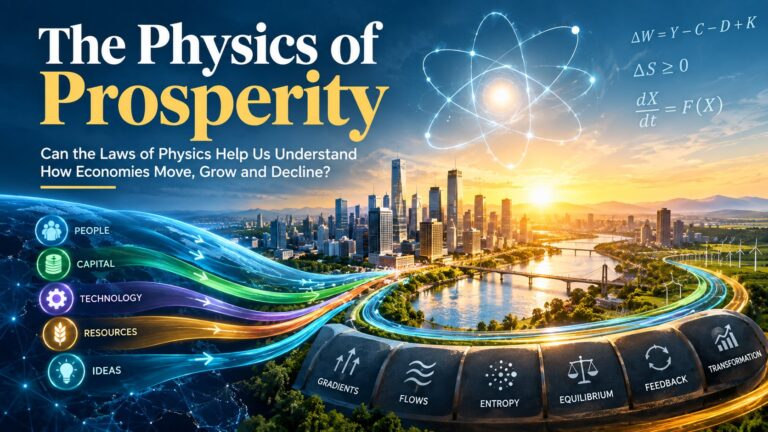
What if an economy could be looked at not merely as a collection of markets, firms, consumers and governments, but as a dynamic system?
Physicists do not understand the universe simply by listing its objects. They ask deeper questions: What are the fundamental quantities? What changes them? What flows between systems? What is conserved? What creates equilibrium? Why does a system become unstable? And what happens when a small disturbance becomes large?
Economics asks remarkably similar questions, although it has traditionally developed a very different vocabulary. Economists speak of GDP, capital, labour, consumption, investment, productivity, inflation and wealth. Physics speaks of energy, momentum, temperature, entropy, pressure and fields.
The intriguing possibility is not that economics is secretly physics, but that some of the conceptual tools of physics might help us see economic phenomena differently.
Perhaps the economy has its own gradients, flows, frictions, equilibria and forms of entropy.
And perhaps our obsession with measuring economic growth has distracted us from the more important question: what actually makes prosperity move?
GDP is not a thermometer
Consider a simple physical experiment.
Two bodies are placed in contact. Body A has a temperature of 80°C and body B has a temperature of 20°C. Assuming the necessary conditions for heat transfer exist, we know the direction of heat flow: from A towards B.
The temperature difference is not merely a number describing the two bodies. It has dynamical significance.
Now consider two economies.
Country A has GDP per capita of $60,000 and Country B has GDP per capita of $6,000.
What happens?
We cannot say with certainty that “prosperity” will flow from A to B.
Capital might move from A to B in search of higher returns. Workers might move from B to A in search of higher wages. Technology might move from A to B. Profits generated in B might flow back to investors in A. Goods might move in both directions. Migrants might subsequently send remittances from A to B.
The economic gradient produces incentives, not an inevitable physical flow.
This is the crucial distinction.
A temperature gradient produces heat flow according to physical laws. An economic gradient produces human responses. \[ \text{Physical gradient} \rightarrow \text{physical flow} \]
whereas: \[ \text{Economic gradient} \rightarrow \text{incentive} \rightarrow \text{human behaviour} \rightarrow \text{economic flow}. \]
The additional term—human agency—is what makes economics so much more complicated.
From measurement to dynamics
This distinction becomes particularly important when we discuss GDP.
GDP is an enormously useful statistic. It attempts to measure the value of final goods and services produced within an economy during a particular period. But GDP is not an object sitting inside an economy waiting to be measured with a perfectly calibrated instrument.
It is a statistical construction.
Definitions have to be established. Data have to be collected. Informal activity has to be estimated. Prices have to be adjusted. Different components have to be reconciled. Statistical methods have to be revised.
This does not make GDP meaningless.
Quite the opposite.
It means that GDP should be understood as a measurement system, not as a direct physical property of the economy.
A thermometer tells us the temperature.
GDP tells us something about the scale and growth of measured economic production.
But neither measurement, by itself, explains the dynamics that produced the observed change.
If GDP rises from 100 to 108, we know that the measured economy has expanded by roughly 8 per cent under the relevant methodology.
But we still have to ask:
Why?
Was it investment?
Productivity?
Consumption?
Exports?
Government spending?
Population growth?
Credit expansion?
Technological change?
A temporary statistical effect?
Or some combination?
Measurement describes the state. Dynamics explains the transition between states.
Is there an economic equivalent of a gradient?
Physics becomes powerful because differences matter.
A difference in temperature creates a thermal gradient.
A difference in pressure can drive fluid movement.
A difference in electrical potential can drive current.
A difference in concentration can drive diffusion.
Could economics have analogous gradients?
It already has many.
Wage gradient
\[ W_A > W_B \]
can encourage workers to move from B to A.
Return-on-capital gradient
\[ R_A < R_B \]
can encourage capital to move from A to B.
Price gradient
Differences in prices can generate trade and arbitrage.
Productivity gradient
Differences in productivity can create incentives for technology transfer, investment and organisational change.
Interest-rate gradient
Differences in financial returns can generate international capital movements.
Opportunity gradient
Differences in education, employment, security and living standards can generate migration.
The economy is therefore full of gradients.
But there is no single “economic temperature” that combines all of them.
This may be one reason economic dynamics are so difficult to capture with a single indicator such as GDP.
What, then, flows?
Once we begin thinking in terms of gradients, another question follows naturally:
What actually flows through an economy?
The answer is surprisingly broad.
Money flows.
Capital flows.
Goods flow.
Services flow.
Labour flows.
Information flows.
Technology flows.
Credit flows.
Profits flow.
Risk flows.
And increasingly, data and computing capacity flow.
These flows interact.
Capital can create factories.
Factories create employment.
Employment creates income.
Income creates consumption.
Consumption creates demand.
Demand creates investment.
Investment creates additional productive capacity.
The system therefore contains feedback loops: \[ \text{Capital} \rightarrow \text{Production} \rightarrow \text{Income} \rightarrow \text{Demand} \rightarrow \text{Investment} \rightarrow \text{Capital}. \]
This is not a simple linear machine.
It is a dynamic system.
The first possible law: conservation
Here physics offers an interesting conceptual lesson.
The first law of thermodynamics tells us that energy is conserved: it can change form, but it cannot simply appear from nowhere or disappear without accounting for where it went.
Economics does not have an exact equivalent, but it does possess powerful accounting conservation principles.
Income can be: \[ \text{consumed} + \text{saved}. \]
Saving can finance: \[ \text{investment}. \]
Investment can create: \[ \text{productive capital}. \]
Capital can generate: \[ \text{future income}. \]
This suggests a candidate principle:
Economic resources can be transformed, accumulated, transferred or consumed, but sustainable wealth ultimately requires the creation, preservation or more productive use of real resources.
This qualification matters because money is not the same thing as wealth.
A financial system can create enormous quantities of monetary claims without creating an equivalent quantity of houses, machines, food, energy, skills or technological capability.
The distinction between financial wealth and real wealth therefore becomes essential.
The second possible law: economic entropy
The most provocative analogy with physics may be entropy.
A machine does not remain efficient forever.
Infrastructure deteriorates.
Machines wear out.
Skills become obsolete.
Technologies become outdated.
Organisations accumulate bureaucracy.
Institutions can become inefficient.
Knowledge can become obsolete.
Natural resources can become depleted.
Even a successful economy therefore faces a continuous tendency towards decay and obsolescence.
A useful conceptual equation might be: \[ \text{Economic order} = \text{investment} + \text{maintenance} + \text{learning} + \text{innovation} – \text{decay}. \]
This is not a thermodynamic equation. It is a conceptual analogy.
But it reveals something important.
A prosperous economy is not one that has somehow defeated entropy permanently.
It is one that has developed the capacity to continually overcome economic decay.
Roads have to be repaired.
Factories have to be upgraded.
Workers have to learn.
Institutions have to adapt.
Businesses have to innovate.
Universities have to produce knowledge.
Technologies have to evolve.
Thus prosperity may be understood not merely as the accumulation of wealth, but as the continuous maintenance and expansion of productive order.
Development as an entropy problem
This perspective gives us an intriguing way to think about economic development.
A poor economy may have:
- weak infrastructure,
- low productivity,
- inadequate human capital,
- poor institutions,
- limited savings,
- technological constraints,
- unreliable energy,
- weak connectivity.
Each deficiency reinforces another.
Low productivity produces low income.
Low income produces low savings.
Low savings restrict investment.
Low investment limits productivity.
The system can become trapped in a self-reinforcing state.
In simplified form: \[ \text{Low productivity} \rightarrow \text{Low income} \rightarrow \text{Low saving} \rightarrow \text{Low investment} \rightarrow \text{Low productivity}. \]
Development then becomes an attempt to break the feedback loop.
This is where economic policy becomes analogous, in a loose sense, to supplying energy to a system to create and maintain order.
Education, infrastructure, technology, institutions and investment are not merely “expenses”.
They can be mechanisms for reducing economic friction and increasing productive complexity.
The third possible law: economic equilibrium is never still
Physics often studies equilibrium.
Economics does too.
Prices respond to supply and demand. Labour markets respond to wages. Capital responds to returns. Consumers respond to prices. Firms respond to profits.
But economic equilibrium has a peculiar property:
the agents themselves respond to the conditions of the system.
Suppose wages in A are much higher than in B.
Workers in B may migrate to A.
But that migration changes labour supply in A.
Wages in A may therefore change.
The population of B falls.
Labour scarcity may emerge in B.
Wages in B may rise.
The original gradient begins to change.
The system has responded to its own state.
This suggests a third conceptual principle:
Economic differences generate behavioural responses that alter the differences themselves.
That makes economic equilibrium fundamentally different from a static physical equilibrium.
It is better understood as a moving equilibrium.
Why economic systems can suddenly change
Here another concept from physics becomes fascinating: phase transitions.
Water can exist as ice, liquid or vapour. A relatively small change in temperature can produce a dramatic change in its state under appropriate conditions.
Economic systems can also exhibit sudden transitions.
A financial market can move from confidence to panic.
A bank can move from apparent stability to insolvency.
An economy can move from rapid expansion to recession.
A technology can remain marginal for years and then suddenly become dominant.
A social trend can spread slowly and then explode.
These phenomena are often associated with non-linear feedback.
For example: \[ \text{Price rises} \rightarrow \text{optimism} \rightarrow \text{more buying} \rightarrow \text{higher price} \rightarrow \text{greater optimism}. \]
The reverse can happen during a crash.
This means that economic systems may contain tipping points.
The important lesson is that the response of an economic system need not be proportional to the initial disturbance.
A small shock can sometimes produce a large consequence.
But there is a danger in the physics analogy
We should be careful.
An economy is not a gas in a container.
People are not molecules.
Markets do not obey the laws of thermodynamics.
An electron does not change its behaviour because it has read an economics textbook.
Humans do.
This creates reflexivity.
If economists predict that a currency will collapse, people may sell it, causing the prediction to become true.
If everyone expects a recession, firms may reduce investment, helping create the recession.
If everyone believes house prices will rise, they may rush to buy houses, pushing prices higher.
The observer can therefore become part of the system.
This is one of the greatest obstacles to constructing an exact “physics of economics”.
Perhaps economics needs state variables of its own
Physics becomes extraordinarily powerful because it identifies a relatively small number of variables capable of describing enormous systems.
Could economics do something similar?
Instead of asking only:
“What is GDP growth?”
we might ask: \[ \text{What is the state of the economic system?} \]
Perhaps the state would involve: \[ \boxed{ Y,\ K,\ L,\ P,\ W,\ H,\ T,\ I } \]
where, conceptually:
- \(Y\) = output/income
- \(K\) = productive capital
- \(L\) = labour
- \(P\) = productivity
- \(W\) = wealth
- \(H\) = human capital
- \(T\) = technological capability
- \(I\) = institutional quality.
Then economic dynamics could be represented as: \[ \frac{dX}{dt}=F(X,\text{institutions},\text{expectations},\text{technology},\text{environment}) \]
where \(X\) represents the economic state.
This would shift our attention from economic snapshots to economic trajectories.
And that may be the deeper lesson from physics.
From GDP growth to prosperity dynamics
Suppose two countries both report 7 per cent GDP growth.
At first glance they look identical.
But imagine:
Country A
- productivity rising;
- real wages rising;
- employment expanding;
- capital formation strong;
- technological capability improving;
- inequality stable or declining.
Country B
- growth driven primarily by debt;
- asset prices rising;
- employment stagnant;
- productivity weak;
- household purchasing power falling;
- wealth concentrated.
Both have: \[ GDP\ growth=7\%. \]
Yet their economic states are completely different.
This is why the physics-inspired approach is valuable.
It encourages us to ask not merely:
How fast is the economy growing?
but:
What forces are producing the growth, what flows are sustaining it, and where is the system heading?
Towards a physics of prosperity
Perhaps, therefore, we should stop searching for an economic equivalent of temperature and instead search for a vector of economic conditions.
Prosperity might depend upon: \[ \text{Prosperity} = f( \text{income}, \text{wealth}, \text{productivity}, \text{health}, \text{education}, \text{security}, \text{opportunity}, \text{environment} ). \]
An economy would then have not one gradient but many.
There would be a wage gradient.
A productivity gradient.
A technology gradient.
A capital-return gradient.
An opportunity gradient.
These gradients would generate flows of people, money, knowledge, technology and goods.
The interaction of these flows would produce the evolving economic system.
The ultimate challenge would be to understand whether these flows can be expressed through a small number of general principles.
The real promise of the idea
The purpose of viewing economics through physics is therefore not to replace economics with equations from thermodynamics.
It is to ask better questions.
Instead of seeing GDP as an isolated number, we can see it as a state variable.
Instead of seeing migration merely as a demographic statistic, we can see it as a response to an economic gradient.
Instead of seeing investment merely as expenditure, we can see it as a flow that changes the future productive state.
Instead of seeing technological obsolescence as an unfortunate event, we can see it as a form of economic entropy.
Instead of seeing recessions simply as declines in GDP, we can investigate the feedback mechanisms and instabilities that produce them.
And instead of thinking about equilibrium as a final destination, we can think of the economy as a system perpetually moving towards—and away from—different temporary equilibria.
A new way of asking an old question
The central question of economics has traditionally been something like:
How does an economy allocate scarce resources?
The physics-inspired question would be slightly different:
How does an economic system transform, accumulate and dissipate resources, and how do gradients, flows, feedback and entropy determine its trajectory through time?
That is a much more dynamic question.
And it brings us back to GDP.
A GDP growth rate of 7.8 per cent—or 5 per cent, or 10 per cent—is ultimately a measurement of an economic process. It is important, but it is not the entire story.
The deeper story is about what is flowing, what is accumulating, what is deteriorating, what is being created, and what forces are driving the system from one state to another.
Physics teaches us that understanding a system requires more than measuring its current state.
We must understand its laws of motion.
Perhaps economics has spent centuries learning how to measure the economy—and is only beginning to ask what its laws of motion might be.
And that may be where the real physics of prosperity begins.