
Introduction
The history of human civilization is closely linked to humanity’s ability to harness natural resources. From the agricultural revolution to the industrial age and the modern technological era, economic progress has depended upon the extraction, transformation, and consumption of materials and energy from the environment. While these developments have improved living standards, increased life expectancy, and expanded economic opportunities, they have also generated unprecedented environmental challenges.
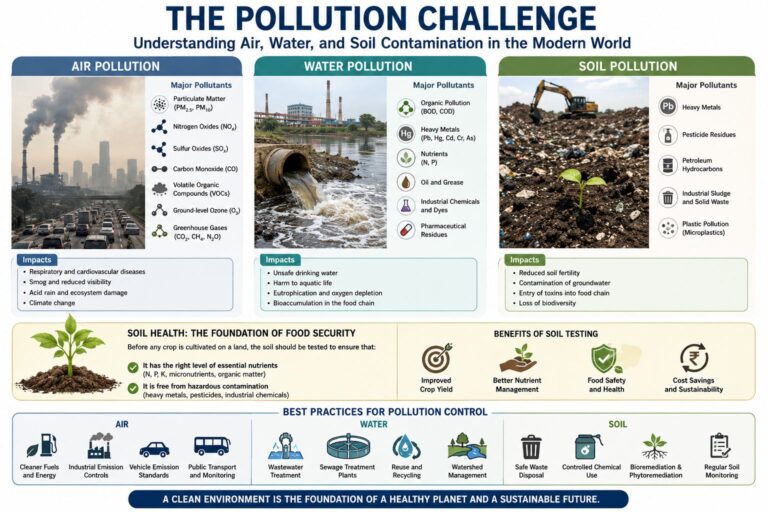
Among these challenges, pollution stands out as one of the most significant threats to both ecological stability and human well-being. Air pollution contributes to respiratory diseases and climate change. Water pollution threatens drinking water supplies, aquatic ecosystems, and food security. Soil pollution reduces agricultural productivity and introduces harmful contaminants into the food chain. Together, these forms of pollution impose enormous economic, social, and ecological costs on societies around the world.
Understanding the nature of pollution, its sources, and its impacts is therefore essential for developing effective mitigation strategies. Before discussing advanced technological solutions such as environmental catalysis and biotechnology, it is necessary to understand the problem itself.
What Is Pollution?
Pollution may be defined as the introduction of substances or forms of energy into the environment at concentrations that cause harmful effects to living organisms, ecosystems, property, or human activities.
Pollutants may be released intentionally or unintentionally and can originate from natural or human activities. However, the scale and intensity of pollution observed today are largely the result of human activities such as industrial production, transportation, agriculture, urbanization, and waste generation.
Pollutants are often classified into two categories:
Point-Source Pollution
Point-source pollution originates from identifiable and localized sources such as:
- Industrial discharge pipes
- Power plant smokestacks
- Municipal sewage outlets
- Chemical manufacturing facilities
Because the source is identifiable, point-source pollution is generally easier to regulate and control.
Non-Point Source Pollution
Non-point source pollution arises from diffuse sources that cannot be easily traced to a single location.
Examples include:
- Agricultural runoff
- Urban stormwater runoff
- Atmospheric deposition
- Soil erosion
These pollutants often enter rivers, lakes, and groundwater over large geographic areas, making management more challenging.
Major Air Pollutants
Air pollution is among the most visible and widely studied environmental problems. Modern urban and industrial societies emit a wide variety of gaseous and particulate pollutants.
Particulate Matter (PM)
Particulate matter consists of tiny solid particles and liquid droplets suspended in the atmosphere.
Two categories are particularly important:
- PM₁₀ (particles smaller than 10 micrometres)
- PM₂.₅ (particles smaller than 2.5 micrometres)
PM₂.₅ is especially dangerous because it can penetrate deep into the lungs and enter the bloodstream.
Major sources include:
- Vehicle exhaust
- Coal combustion
- Industrial emissions
- Construction activities
- Biomass burning
Particulate matter is associated with respiratory diseases, cardiovascular disorders, and premature mortality.
Nitrogen Oxides (NOₓ)
Nitrogen oxides are produced primarily during high-temperature combustion processes.
Major sources include:
- Automobiles
- Thermal power plants
- Industrial furnaces
NOₓ contributes to:
- Smog formation
- Acid rain
- Ground-level ozone production
- Respiratory illnesses
Sulfur Oxides (SOₓ)
Sulfur dioxide is produced when sulfur-containing fuels are burned.
Major sources include:
- Coal-fired power plants
- Refineries
- Metal smelting operations
Sulfur oxides contribute to acid rain and respiratory irritation.
Carbon Monoxide (CO)
Carbon monoxide is generated through incomplete combustion.
Major sources include:
- Motor vehicles
- Domestic fuel combustion
- Industrial processes
Because carbon monoxide binds strongly to hemoglobin, it reduces the blood’s ability to transport oxygen.
Volatile Organic Compounds (VOCs)
VOCs include numerous carbon-containing chemicals such as benzene, toluene, and xylene.
Sources include:
- Fuel evaporation
- Paints and solvents
- Petrochemical industries
VOCs play a major role in photochemical smog formation.
Ground-Level Ozone
Unlike ozone in the upper atmosphere, ground-level ozone is a harmful pollutant.
It forms when sunlight triggers reactions between NOₓ and VOCs.
Ozone can damage:
- Human lungs
- Crops
- Forest ecosystems
Greenhouse Gases
The most important greenhouse gases include:
- Carbon dioxide (CO₂)
- Methane (CH₄)
- Nitrous oxide (N₂O)
Although not directly toxic at typical concentrations, they contribute to global climate change.
Major Water Pollutants
Water is essential for life, agriculture, industry, and ecosystem functioning. Unfortunately, rivers, lakes, groundwater, and coastal waters are increasingly exposed to contamination.
Organic Pollution
Organic pollutants originate from:
- Sewage
- Food processing industries
- Distilleries
- Agricultural wastes
Their impact is commonly measured through:
- Biological Oxygen Demand (BOD)
- Chemical Oxygen Demand (COD)
High organic loads consume dissolved oxygen and can lead to fish kills and ecosystem collapse.
Heavy Metals
Heavy metals are among the most dangerous water pollutants because they do not degrade easily.
Examples include:
- Lead
- Mercury
- Cadmium
- Chromium
- Arsenic
Sources include:
- Mining
- Electroplating
- Battery manufacturing
- Tanneries
Many heavy metals accumulate in living organisms and may cause neurological, developmental, and carcinogenic effects.
Nutrient Pollution
Excess nitrogen and phosphorus often enter water bodies through:
- Fertilizer runoff
- Sewage discharges
- Livestock operations
These nutrients stimulate excessive algal growth, leading to eutrophication and oxygen depletion.
Oil and Grease
Petroleum pollution originates from:
- Refineries
- Shipping operations
- Fuel spills
Oil contamination harms aquatic organisms and disrupts ecological processes.
Industrial Chemicals and Dyes
Numerous industrial processes release:
- Synthetic dyes
- Phenols
- Solvents
- Toxic organic compounds
Many of these substances are persistent and difficult to remove through conventional treatment methods.
Pharmaceutical Residues
Modern wastewater increasingly contains:
- Antibiotics
- Hormones
- Painkillers
- Personal care products
These compounds are emerging contaminants of global concern.
Major Soil Pollutants
Soil serves as the foundation of terrestrial ecosystems and agriculture. Unlike air pollution, soil contamination often remains hidden for years before its consequences become apparent.
Heavy Metal Contamination
Heavy metals may accumulate through:
- Industrial emissions
- Mining activities
- Waste disposal
- Contaminated irrigation water
Once introduced into soil, many metals remain for decades.
Pesticide Residues
Agricultural pesticides can persist in soil and affect:
- Soil microorganisms
- Beneficial insects
- Groundwater quality
Excessive pesticide accumulation may also impact food safety.
Petroleum Hydrocarbons
Oil spills, fuel leaks, and industrial accidents can introduce hydrocarbons into soils.
These pollutants reduce soil fertility and may contaminate groundwater.
Industrial Sludge and Solid Waste
Improper disposal of industrial wastes may introduce:
- Heavy metals
- Toxic chemicals
- Persistent organic pollutants
Such contamination can render land unsuitable for agriculture.
Plastic Pollution
Microplastics and larger plastic fragments are increasingly being detected in agricultural soils worldwide.
Their long-term ecological impacts remain an active area of research.
Emerging Pollutants
Scientific attention has increasingly focused on pollutants that were previously overlooked.
Microplastics
Microplastics originate from:
- Plastic waste degradation
- Synthetic textiles
- Industrial products
They have now been detected in oceans, rivers, soils, food products, and even the atmosphere.
PFAS: The “Forever Chemicals”
Per- and polyfluoroalkyl substances are used in:
- Non-stick cookware
- Firefighting foams
- Industrial coatings
These compounds resist degradation and can persist in the environment for decades.
Nanomaterials
The growing use of nanotechnology has introduced engineered nanoparticles into the environment.
The long-term ecological consequences remain uncertain.
Best Practices for Air Pollution Mitigation
Effective air pollution control requires prevention at the source.
Key strategies include:
- Cleaner fuels
- Renewable energy adoption
- Industrial emission controls
- Vehicle emission standards
- Dust management
- Public transportation systems
- Continuous air quality monitoring
Technologies such as electrostatic precipitators, bag filters, and flue-gas desulfurization systems have significantly reduced emissions in many industries.
Best Practices for Water Pollution Mitigation
Water pollution management follows a hierarchy:
- Prevention
- Treatment
- Reuse
- Monitoring
Key measures include:
- Industrial wastewater treatment
- Sewage treatment plants
- Nutrient management
- Wetland restoration
- Water recycling
- Continuous monitoring
The protection of water resources increasingly requires integrated watershed management approaches.
Best Practices for Soil Pollution Mitigation
Soil protection begins with preventing contamination.
Important strategies include:
- Safe waste disposal
- Controlled chemical use
- Hazardous waste management
- Bioremediation
- Phytoremediation
- Soil stabilization
Maintaining healthy soil biological activity is essential for long-term sustainability.
Soil Health and Sustainable Agriculture
Healthy soil is one of humanity’s most valuable resources.
However, many agricultural systems rely on fertilizer application without first understanding the condition of the soil itself.
Why Soil Testing Matters
Before cultivating a crop, two fundamental questions should be answered:
- Does the soil contain adequate nutrients?
- Is the soil free from hazardous contamination?
Testing should ideally include:
- Nitrogen
- Phosphorus
- Potassium
- Micronutrients
- pH
- Organic matter
- Heavy metals
- Pesticide residues
Such assessments enable precision agriculture and reduce unnecessary fertilizer use.
The Concept of a Soil Health Passport
Many scientists advocate the creation of a “soil health passport” for agricultural land.
This would periodically record:
- Fertility status
- Contamination levels
- Organic carbon content
- Biological health indicators
Such a system could improve productivity, food safety, and environmental protection.
Conclusion
Pollution is one of the defining environmental challenges of the twenty-first century. Air pollution threatens public health, water pollution undermines ecosystems and food security, and soil contamination compromises agricultural productivity and environmental resilience.
The complexity of modern pollution requires a comprehensive understanding of pollutant sources, environmental pathways, and mitigation strategies. While prevention remains the most effective solution, scientific advances continue to provide new tools for managing environmental contamination.
Understanding the nature of pollution is the first step toward solving it. Once the problem is clearly understood, attention can turn to the technologies that make remediation possible. Among these technologies, catalysis stands out as one of the most powerful scientific innovations for accelerating pollutant destruction and environmental restoration. The next article in this series will explore how catalysts work and why they have become indispensable tools in modern pollution control.