
Why Inequality Does Not Disappear Like Water—and What Economics Can Learn from Mechanics
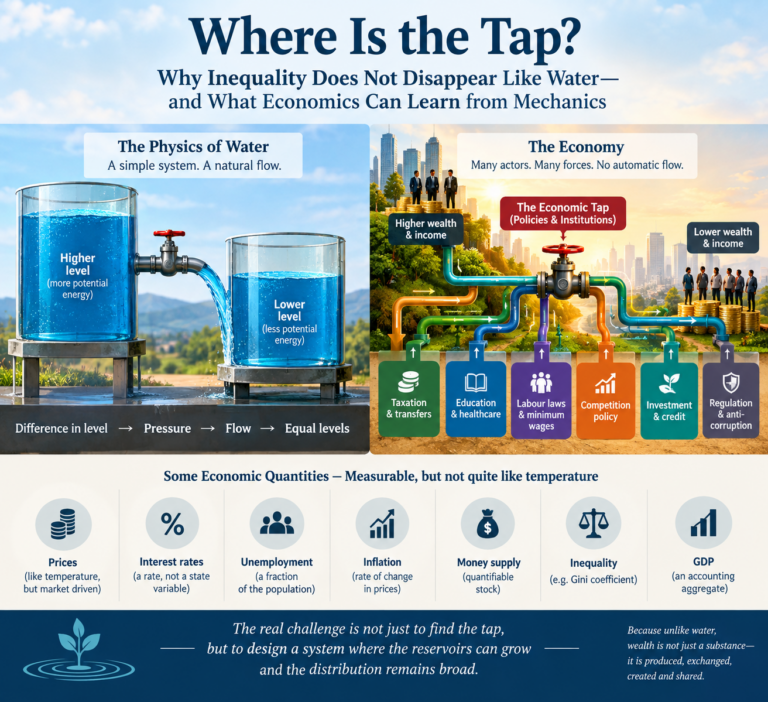
Imagine a tank of water divided into two chambers, one containing water at a much higher level than the other. Open a connecting tap and something inevitable happens: water begins to flow from the higher level towards the lower one. The flow continues until the difference in levels disappears and equilibrium is reached.
There is no committee deciding where the water should go. No law needs to be passed. No moral argument is required. The system itself generates the flow.
Now consider an economy.
Some individuals possess enormous quantities of wealth while others possess very little. Some households own several properties, businesses and financial assets; others struggle to meet basic expenses. Yet, unlike water, wealth does not automatically flow from the rich to the poor until everyone reaches the same level.
Why?
Where is the economic equivalent of the tap?
The elegance of the physical world
Mechanics provides remarkably simple examples of spontaneous movement towards equilibrium.
Water flows downhill because a difference in gravitational potential produces a force. Heat flows from a hotter body to a colder one because of a temperature difference. Gases spread from regions of high pressure towards regions of low pressure.
In each case, a measurable difference creates a tendency for movement.
We can represent the basic idea schematically:
Difference → force → flow → equilibrium
Economics contains many phenomena that superficially resemble this pattern.
Differences in wages can encourage workers to move between occupations and regions. Differences in returns can encourage capital to move between investments. Differences in prices can trigger arbitrage. Shortages can attract production, while excess supply can reduce prices.
Yet inequality in wealth and income does not behave like a simple difference in water levels.
A person with ₹100 million does not automatically transfer money to someone with ₹10,000 simply because the difference is enormous.
The economic system has no equivalent of gravity that mechanically forces wealth towards the lower end.
Perhaps price is the closest thing to an economic thermometer
This raises a broader question: does economics possess quantities that can be measured in the same spirit as temperature in physics?
There are several candidates.
Prices can be directly observed. Interest rates can be measured. Unemployment can be estimated. Inflation can be calculated as the rate of change of a price index. Money supply can be quantified. Inequality can be represented through measures such as the Gini coefficient.
But none has quite the same status as temperature.
Temperature is a physical state variable. A calibrated thermometer can be placed in a system and produce a measurement according to a reproducible physical relationship.
GDP is different. It is an accounting aggregate constructed from millions of economic activities. It combines cars, software, medical treatment, financial services, education and countless other things using monetary valuation.
There is therefore no simple physical instrument that can be placed inside an economy and display:
GDP = ₹X trillion
Economics measures the economy through a network of observations rather than through a single fundamental sensor.
Why doesn’t wealth flow like water?
The crucial reason is that wealth is not simply a substance.
Water is physically conserved within the system. If one reservoir loses 100 litres, another reservoir can gain roughly those 100 litres.
Economic wealth is different.
Suppose an entrepreneur invests ₹10 lakh and develops a successful technology. The resulting economic value may be vastly greater than the original investment.
Conversely, a company can lose billions of rupees through technological failure, bad investment or destruction of productive assets.
Economic systems therefore simultaneously involve:
production + destruction + exchange + accumulation + distribution.
The “water” itself can change in quantity.
There is another difference. Water does not care whether the person operating the valve worked for the water or did nothing. Economic resources are embedded in property rights, contracts, incentives, institutions and human behaviour.
Consequently, simply transferring resources from one person to another does not necessarily produce the same economic result as moving water between two tanks.
So what is the economic tap?
If there is no natural force that equalises wealth, society has to construct mechanisms that influence its distribution.
The closest equivalents to taps and valves are institutions and public policy.
Progressive taxation can transfer a greater proportion of income from higher earners towards public expenditure and transfers.
Social security can provide income to people who have lost employment or cannot work.
Public education and healthcare can redistribute access to important economic capabilities without directly transferring cash.
Minimum-wage laws and labour institutions can influence the distribution of earnings.
Competition policy can constrain monopoly power and economic rents.
Inheritance taxation can affect the transmission of wealth between generations.
Education, infrastructure and access to finance can increase the capacity of people with fewer assets to participate in productive activity.
In our analogy:
Taxation and transfers are valves.
Markets are pipes.
Investment is a pump.
Production and innovation are generators.
Corruption, destruction and economic inefficiency are leaks.
But unlike a hydraulic system, these components are operated by human beings.
The problem with simply opening the tap
Suppose two people have dramatically different amounts of wealth.
If we simply transfer wealth from the richer person until both possess exactly the same amount, we have achieved equality in one particular dimension.
But we may have changed the incentives that produced the wealth in the first place.
If investment is heavily discouraged, less capital may be accumulated. If entrepreneurship becomes less attractive, fewer businesses may be created. If additional effort produces little additional reward, some people may reduce their productive effort.
The result could be a more equal distribution—but potentially a smaller economic reservoir.
This reveals something that the water analogy initially conceals:
In economics, the distribution of the water can affect the process that produces more water.
A hydraulic system does not become less efficient because water is redistributed between reservoirs. An economy can.
This is why the economic problem cannot simply be:
“How do we equalise the levels?”
It must also ask:
“How do we maintain or increase the rate at which the system generates wealth?”
Equality is not the only possible equilibrium
There is another subtle point.
In physics, equilibrium often means that a particular gradient has disappeared. Two bodies at the same temperature are in thermal equilibrium.
But what should economic equilibrium mean?
Should everyone have identical wealth?
Identical income?
Identical consumption?
Identical opportunities?
Identical access to education and healthcare?
These are very different objectives.
An economy could have substantial inequality of wealth while providing broad access to education, healthcare and economic opportunity. Another economy could have relatively compressed incomes while offering fewer opportunities for advancement.
Thus, unlike temperature, there is no single universally accepted economic variable whose equalisation defines social equilibrium.
The more interesting economic “thermometer”
Perhaps the ultimate challenge is not to find an economic tap but to discover whether the economy possesses deeper measurable state variables.
Imagine an instrument capable of continuously observing:
- inflation,
- unemployment,
- capacity utilisation,
- wages,
- credit,
- investment,
- consumption,
- productivity,
- asset prices,
- trade,
- energy use and
- business formation.
Could these measurements be combined into something analogous to an economic temperature?
Could an economy be described as being in a state of high or low economic pressure?
Could differences in such a variable predict flows of labour and capital?
Could economic “potential” be defined mathematically?
And could we identify something analogous to entropy—a measure of the dispersion, disorder or irreversibility of economic systems?
These are not merely metaphorical questions. They point towards one of the most fascinating possibilities in economic science: developing a more systematic theory of the economy as a dynamic physical-like system, while recognising that human expectations, institutions and choices make it fundamentally different from an ordinary mechanical system.
From tanks to economies
The tank of water gives us an extraordinarily simple picture:
higher level → pressure difference → flow → equilibrium.
The economy is considerably more complicated:
inequality → incentives, institutions and social pressures → economic flows → changing production and distribution.
There is no automatic gravitational force pulling wealth towards equality.
There are instead markets, institutions, governments and human decisions that determine how resources move.
The challenge, therefore, is not simply to find the tap that makes everyone else’s water level equal.
It is to design a system in which the reservoirs can grow while the distribution remains sufficiently broad that economic opportunity does not become permanently concentrated.
Perhaps that is where the analogy between physics and economics becomes most useful.
Physics asks:
What forces make a system move towards equilibrium?
Economics must additionally ask:
What institutions determine the direction of the flow—and how does that flow change the system itself?
That extra question is precisely what makes economics more difficult than mechanics—and perhaps also what makes it so fascinating.